
Are Pour Over Coffee Makers Worth It?
Quick answer
- Pour over coffee makers offer significant control over brewing variables, leading to a highly customizable cup.
- They are generally more affordable than automatic drip machines, especially for entry-level models.
- The brewing process is hands-on and can be a satisfying ritual for many coffee enthusiasts.
- They excel at highlighting the nuanced flavors of quality coffee beans.
- Cleanup is often simple, usually involving rinsing a filter and brewer.
- The resulting coffee is typically clean, bright, and free of sediment.
If you’re looking to elevate your coffee game, a dedicated pour over coffee maker is a fantastic investment. They offer unparalleled control over your brew.

- Pour Over Coffee: Manual Pour Over Coffee Maker allows you to brew an excellent cup of Coffee in minutes
- Stainless steel: Includes a new and improved permanent, stainless steel mesh filter that helps extract your coffee's aromatic oils and subtle flavors instead of being absorbed by a paper filter
- Coffee Carafe: Made of durable, heat-resistant borosilicate glass with Cork Band detailing that is both functional and elegant; single wall
- Quick and Easy: Simply add coarse ground Coffee to filter, pour a small amount of water in a circular motion over ground Coffee until soaked then add the remaining water and let drip
- Servings: Pour Over Coffee Maker makes 8 cups of Coffee, 4 oz each; dishwasher safe
Key terms and definitions
- Bloom: The initial wetting of coffee grounds, allowing trapped gases to escape, which is crucial for even extraction.
- Drip rate: The speed at which water flows through the coffee grounds and filter.
- Extraction: The process of dissolving desirable flavors and aromas from coffee grounds into water.
- Grind size: The fineness or coarseness of ground coffee, a critical factor in extraction.
- Gooseneck kettle: A kettle with a long, slender spout designed for precise water pouring.
- Ratio (brew ratio): The proportion of coffee grounds to water used in brewing, often expressed as grams of coffee per milliliters of water.
- Sediment: Fine coffee particles that pass through the filter into the brewed coffee.
- Single-origin coffee: Coffee beans sourced from a single geographical location, often prized for distinct flavor profiles.
- Slurry: The mixture of coffee grounds and water during the brewing process.
- Total Dissolved Solids (TDS): A measure of the concentration of dissolved coffee solids in a brew, indicating strength.
How it works
- Water is heated to a specific temperature, typically between 195°F and 205°F.
- Coffee beans are ground to a consistent size, usually medium-fine, suitable for the specific pour over device.
- A filter (paper, cloth, or metal) is placed in the pour over cone and rinsed with hot water to remove paper taste and pre-heat the brewer.
- Ground coffee is added to the filter, often leveled gently.
- A small amount of hot water is poured over the grounds, just enough to saturate them, initiating the bloom phase for 30-45 seconds.
- After the bloom, hot water is poured slowly and evenly over the grounds in concentric circles, aiming to maintain a consistent water level.
- The water drips through the coffee bed and filter, extracting soluble compounds, and collects in a carafe or mug below.
- The pouring process is continued in stages until the desired amount of coffee is brewed, typically within 2-4 minutes total brew time.
- The spent grounds and filter are discarded, and the fresh coffee is ready to serve.
The heart of the pour over process is the coffee dripper itself. A quality dripper, like this popular option, ensures even water flow for optimal extraction.
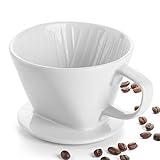
- Portable Handmade Brew - DOWAN ceramic pour-over coffee dripper lets you have a traditional, hands-on brewing experience. You can have a cup or two of coffee whenever and wherever you want, without the help of a machine.
- Three holes Dripping Design - The unique three-hole drip design makes the coffee flow more concentrated, and ensures the proper brewing time to fully extract the coffee flavor.
- Thoughtful Design - The V-shaped conical design can make the coffee powder pile higher, thereby prolonging the contact time with water and making it easy to fully infuse the coffee.
- Inner Wall Vertical Rib - The inner wall of this coffee pour over adopts a vertical groove design, and the distance between the filter paper and the wall of the filter cup is reserved to fully extract the coffee essence. (filter paper is NOT included)
- High Quality Material: The pour-over coffee maker is made of high-fired ceramic, with good heat preservation and durability. This coffee dripper can greatly prevents heat loss than wire mesh filter during brewing, fit for most mugs and thermoses.
What affects the result in do pour over coffee makers make good coffee
- Water Quality: Filtered or spring water is ideal. Tap water with high mineral content or chlorine can negatively impact flavor.
- Grind Size: Too fine a grind can lead to over-extraction and bitterness; too coarse can result in under-extraction and sourness. Consistency is key.
- Coffee-to-Water Ratio: A common starting point is 1:15 to 1:17 (e.g., 1 gram of coffee to 15-17 grams of water). Adjusting this affects strength.
- Water Temperature: Brewing water between 195°F and 205°F is generally recommended. Too hot can burn, too cold can under-extract.
- Pouring Technique: Slow, controlled, and even pouring ensures uniform saturation and extraction of the coffee grounds. A gooseneck kettle helps immensely.
- Bloom Duration: Allowing enough time for the coffee to bloom (30-45 seconds) ensures trapped gases escape, leading to better, more even extraction.
- Brew Time: The total time water is in contact with the coffee, typically 2-4 minutes for pour over. Too short or too long affects extraction.
- Filter Type: Paper filters produce a cleaner cup, while metal filters allow more oils and fines through, resulting in a fuller body. Cloth filters offer a middle ground.
- Coffee Freshness: Freshly roasted and freshly ground coffee makes a significant difference in flavor and aroma.
- Brewer Design: Different pour over devices (e.g., Hario V60, Chemex, Kalita Wave) have unique geometries affecting flow rate and extraction.
Pros, cons, and when it matters
- Pro: Flavor Clarity: Pour over brewing excels at highlighting the nuanced flavors of specialty coffee beans. This matters for those who appreciate complex tasting notes.
- Pro: Control: Baristas and home brewers have significant control over every variable, allowing for customization to personal taste.
- Pro: Affordability: Many pour over devices are relatively inexpensive, especially compared to automatic machines.
- Pro: Simplicity of Design: Most pour over brewers are simple, durable, and easy to clean.
- Con: Time Commitment: The manual process requires more time and attention than pressing a button on an automatic brewer.
- Con: Learning Curve: Achieving consistent, excellent results can take practice and experimentation with grind size, temperature, and pouring.
- Con: Equipment Needs: While the brewer itself is cheap, a good burr grinder and a gooseneck kettle are highly recommended for optimal results, adding to the initial cost.
- Con: Temperature Stability: Maintaining ideal water temperature throughout the brew can be challenging without specialized equipment.
- When it matters: For coffee enthusiasts who enjoy the ritual of brewing and prioritizing flavor exploration over speed and convenience.
- When it matters: When brewing high-quality, single-origin beans whose delicate flavors might be lost in other brewing methods.
- When it matters: For those seeking a clean cup without sediment, as paper filters effectively trap fines.
Common misconceptions
- Pour over is only for black coffee drinkers. While it excels at black coffee, you can certainly add milk and sugar to a pour over brew if preferred.
- You need to be a barista to make good pour over. While there’s a learning curve, consistent, delicious results are achievable for anyone willing to practice.
- All pour over devices brew the same way. Different designs (e.g., flat-bottom vs. cone-shaped) have distinct impacts on flow rate and extraction.
- Any kettle will do. While you can use any kettle, a gooseneck kettle provides the precise control over water flow essential for optimal pour over technique.
- Dark roasts are best for pour over. Pour over can highlight the delicate notes of light and medium roasts beautifully; it’s not exclusive to any roast level.
- Pour over coffee is always weak. Strength is determined by the coffee-to-water ratio and extraction, which you control. You can make a very strong pour over.
- It’s just filtered coffee, so it’s the same as a drip machine. The manual control over variables in pour over allows for a much more refined and specific extraction than most automatic drip machines.
- You must weigh everything perfectly. While precision helps, you can start with volumetric measurements and adjust to taste.
FAQ
How long does it take to make a pour over coffee?
Typically, the actual brewing process takes between 2 and 4 minutes, not including heating the water or grinding the beans. The total time from start to finish might be 5-8 minutes.
Do pour over coffee makers make good coffee for beginners?
They can, but there’s a slight learning curve. Beginners might find it takes a few tries to get their technique consistent. Starting with a basic recipe and making small adjustments helps.
What’s the main difference between pour over and a French press?
Pour over uses a filter (often paper) to separate the grounds completely, resulting in a clean, bright cup with no sediment. French press steeps coffee and uses a mesh filter, leading to a fuller-bodied cup with more fines.
Can I use pre-ground coffee for pour over?
You can, but for the best results, freshly ground coffee is highly recommended. Pre-ground coffee loses freshness quickly, and its grind size might not be ideal for pour over, affecting extraction.
Is pour over coffee stronger than drip coffee?
Not necessarily. The strength of pour over coffee, like any brew, depends on the coffee-to-water ratio and the degree of extraction. You have more control over these factors with pour over, so you can make it as strong or as mild as you prefer.
How do I clean a pour over coffee maker?
Most pour over brewers (ceramic, glass, plastic) are easy to clean. Simply discard the spent filter and grounds, then rinse the brewer with hot water. Some are dishwasher safe; check the manufacturer’s instructions.
What this page does NOT cover (and where to go next)
- Specific pour over brewer brand comparisons and detailed reviews.
- Advanced techniques like pulse pouring patterns or refractometer use.
- In-depth chemistry of coffee extraction or water mineral content.
- Detailed instructions for calibrating specific grinders.
- How to choose and roast your own green coffee beans.