
Pour Over Coffee vs. Other Methods: Which is Best?
Quick answer
- Pour over coffee offers control and a clean cup.
- It shines for highlighting single-origin bean flavors.
- It requires some technique and patience.
- Other methods like French press offer more body, while espresso is concentrated.
- The “best” way depends on your taste and what you value in a cup.
- For a nuanced, bright coffee, pour over is a strong contender.
Key terms and definitions
- Pour Over: A manual brewing method where hot water is poured over coffee grounds in a filter.
- Bloom: The initial release of CO2 from fresh coffee grounds when hot water is added.
- Grind Size: The coarseness or fineness of coffee particles. Crucial for extraction.
- Extraction: The process of dissolving soluble compounds from coffee grounds into water.
- Ratio: The proportion of coffee grounds to water used in brewing.
- TDS (Total Dissolved Solids): A measure of how much coffee stuff is in your brew.
- Body: The mouthfeel or weight of the coffee on your palate.
- Acidity: The bright, lively, sometimes tart flavors in coffee. Not to be confused with pH.
- Bitterness: A flavor often associated with over-extraction.
- Single-Origin: Coffee from a specific farm or region, showcasing unique characteristics.
How Pour Over Coffee Works
- You start with a filter, usually paper, in a dripper.
- Coffee grounds go into the filter.
- You pre-wet the filter to remove paper taste.
- Then, you add a small amount of hot water to saturate the grounds – this is the bloom.
- After the bloom, you slowly pour the remaining hot water over the grounds.
- The water passes through the grounds and filter, dripping into your mug or carafe.
- This controlled flow is key to the extraction process.
- Different pouring patterns can affect how evenly the water contacts the coffee.
- The result is a clean cup, free of sediment.
- It’s a hands-on way to brew.
To get started with this hands-on brewing method, you’ll need a pour over coffee maker. This allows you to control the water flow precisely.

- Pour Over Coffee: Manual Pour Over Coffee Maker allows you to brew an excellent cup of Coffee in minutes
- Stainless steel: Includes a new and improved permanent, stainless steel mesh filter that helps extract your coffee's aromatic oils and subtle flavors instead of being absorbed by a paper filter
- Coffee Carafe: Made of durable, heat-resistant borosilicate glass with Cork Band detailing that is both functional and elegant; single wall
- Quick and Easy: Simply add coarse ground Coffee to filter, pour a small amount of water in a circular motion over ground Coffee until soaked then add the remaining water and let drip
- Servings: Pour Over Coffee Maker makes 8 cups of Coffee, 4 oz each; dishwasher safe
What Affects Pour Over Coffee Results
- Water Quality: Filtered water is best. Tap water can add unwanted flavors.
- Water Temperature: Too hot, and you’ll scald the grounds. Too cool, and you won’t extract enough. Aim for 195-205°F (90-96°C).
- Coffee Freshness: Recently roasted beans are essential for the best flavor. Old beans taste flat.
- Grind Consistency: A uniform grind ensures even extraction. Inconsistent grinds lead to bitter and sour notes.
- Grind Size: For pour over, a medium grind, like coarse sand, is typical.
- Coffee-to-Water Ratio: The standard is often 1:15 to 1:17 (e.g., 1 gram of coffee to 15-17 grams of water). Adjust to taste.
- Pouring Technique: Slow, steady, circular pours are generally recommended. Avoid pouring directly down the sides.
- Brew Time: How long the water is in contact with the grounds. This is influenced by grind size and pouring speed.
- Dripper Type: Cone shapes, flat bottoms, and different ribbing can affect flow rate.
- Filter Type: Paper filters trap oils for a cleaner cup. Metal filters let more oils through for more body.
- Agitation: Stirring the grounds can increase extraction. Be gentle.
- Altitude: Water boils at lower temperatures at higher altitudes, so you might need to adjust.
The type of coffee dripper you use can influence the flow rate and ultimately the taste of your brew. Different designs offer varying levels of control and forgiveness.
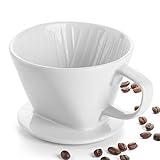
- Portable Handmade Brew - DOWAN ceramic pour-over coffee dripper lets you have a traditional, hands-on brewing experience. You can have a cup or two of coffee whenever and wherever you want, without the help of a machine.
- Three holes Dripping Design - The unique three-hole drip design makes the coffee flow more concentrated, and ensures the proper brewing time to fully extract the coffee flavor.
- Thoughtful Design - The V-shaped conical design can make the coffee powder pile higher, thereby prolonging the contact time with water and making it easy to fully infuse the coffee.
- Inner Wall Vertical Rib - The inner wall of this coffee pour over adopts a vertical groove design, and the distance between the filter paper and the wall of the filter cup is reserved to fully extract the coffee essence. (filter paper is NOT included)
- High Quality Material: The pour-over coffee maker is made of high-fired ceramic, with good heat preservation and durability. This coffee dripper can greatly prevents heat loss than wire mesh filter during brewing, fit for most mugs and thermoses.
Pros, Cons, and When It Matters
- Pro: Unparalleled control over brewing variables. You’re in charge.
- Con: Requires more attention and a bit of practice. Not a “set it and forget it” method.
- Pro: Highlights delicate and nuanced flavors in coffee. Great for exploring origins.
- Con: Can be slower than automatic methods, especially for multiple cups.
- Pro: Produces a very clean, bright cup with minimal sediment.
- Con: Lacks the heavy body and oils found in methods like French press.
- Pro: Relatively inexpensive equipment to get started. A good dripper and filters are affordable.
- Con: Grinder quality is crucial. A cheap grinder will hold you back.
- Pro: Portable and great for camping or travel if you have a heat source. I always pack my V60.
- Con: Requires a kettle with a gooseneck spout for best control.
- Pro: Satisfying ritual for coffee lovers. It’s a mindful process.
- Con: If you’re in a rush, this isn’t your go-to.
Common Misconceptions
- Myth: Pour over is too complicated for beginners.
- Reality: While it takes practice, the basics are simple. Start slow and learn.
- Myth: You need super expensive gear to make good pour over.
- Reality: A decent grinder, a simple dripper, and good beans are the essentials.
- Myth: Paper filters make coffee taste papery.
- Reality: Rinsing the filter well with hot water before brewing removes any paper taste.
- Myth: The faster you pour, the better the extraction.
- Reality: Slow, controlled pouring is key for even extraction. Fast pours can lead to under-extraction.
- Myth: All pour over methods are the same.
- Reality: Different drippers (V60, Chemex, Kalita) have unique designs that affect flow and taste.
- Myth: You must use boiling water.
- Reality: Water just off the boil (195-205°F) is generally ideal. Boiling water can burn the coffee.
- Myth: Any coffee bean works for pour over.
- Reality: Lighter roasts and single-origin beans often shine best with pour over, showcasing their unique flavors.
- Myth: Pour over coffee is always weak.
- Reality: Weakness comes from poor technique or ratio, not the method itself.
FAQ
Q: Is pour over the best way to make coffee for flavor?
A: For highlighting delicate, bright, and nuanced flavors, yes, it’s often considered among the best. It allows you to really taste the origin characteristics of the bean.
Q: How much coffee should I use for pour over?
A: A good starting point is a 1:15 to 1:17 ratio. So, for 300 grams (about 10 oz) of water, use 18-20 grams of coffee. Adjust to your preference.
Q: What kind of grinder is best for pour over?
A: A burr grinder is highly recommended. It produces a more consistent grind size than a blade grinder, which is crucial for even extraction.
Q: How long should a pour over take?
A: Typically, a pour over takes between 2 to 4 minutes from the first pour to the last drip. This can vary based on grind size and volume.
Q: Can I make iced coffee with pour over?
A: Absolutely! You can brew directly over ice, or brew a concentrated batch and dilute it with ice later. It’s a great way to get a clean, bright iced coffee.
Q: What’s the difference between pour over and drip coffee?
A: Automatic drip machines are essentially automated pour over devices. Pour over gives you manual control over every variable, leading to a more nuanced cup if done right.
Q: Does the shape of the dripper matter?
A: Yes, it does. Cone-shaped drippers often have a larger single hole at the bottom, allowing more control over flow. Flat-bottom drippers tend to be more forgiving.
Q: How do I know if my pour over is under-extracted or over-extracted?
A: Under-extracted coffee tastes sour and weak. Over-extracted coffee tastes bitter and dry. You adjust grind size and pour speed to fix these.
What this page does NOT cover (and where to go next)
- Specific recommendations for grinders or kettles.
- Detailed guides for specific pour over devices like the Hario V60 or Chemex.
- The science of coffee roasting and its impact on flavor profiles.
- Advanced techniques like specific pouring patterns or temperature surfing.