
Who Invented The French Press Coffee Maker?
Quick Answer
- The French press wasn’t invented by a single person in France.
- Early patents for similar devices date back to the mid-19th century.
- Italian designers Attilio Calimani and Giulio Moneta patented a significant design in 1929.
- Later, French inventors Mayer and Delforge refined the design in the 1950s, leading to its popularization.
- It’s a story of evolution, not a single Eureka moment.
Key Terms and Definitions
- French Press: A manual coffee brewing device that steeps coffee grounds in hot water, then separates them with a plunger and mesh filter.
- Plunger: The mechanism that pushes down the coffee grounds after brewing.
- Mesh Filter: A fine screen, usually metal, that separates the grounds from the brewed coffee.
- Immersion Brewing: A coffee brewing method where grounds are fully submerged in water for a set time.
- Extraction: The process of dissolving soluble compounds from coffee grounds into water.
- Bloom: The initial release of CO2 gas when hot water first hits fresh coffee grounds.
- Coarse Grind: Coffee grounds that are large and chunky, ideal for French press to prevent sediment.
- Sediment: Fine coffee particles that can pass through the filter, often found at the bottom of the cup.
- Patented: Officially granted a patent, giving the inventor exclusive rights to their invention for a period.
The mesh filter is a crucial component of the French press, ensuring a clean cup. If yours needs replacing or you’re looking for a high-quality option, consider this durable mesh coffee filter.
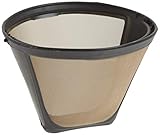
- Genuine Cuisinart Item
- Permanent gold-tone filter
- Helps provide full-flavored coffee
- Cortado con láser
How the French Press Works
- You start with coarsely ground coffee. A good rule of thumb is about 1:15 coffee to water ratio, but adjust to your taste.
- Add the coffee grounds to the bottom of the brewing carafe.
- Pour hot water over the grounds. Aim for around 200°F (93°C). Too hot and you’ll scorch it.
- Let the coffee bloom for about 30 seconds. You’ll see it puff up.
- Stir gently if needed, then place the lid on top, but don’t plunge yet.
- Let the coffee steep for about 4 minutes. This is where the magic happens.
- Slowly and steadily press the plunger down. This pushes the grounds to the bottom.
- Pour your coffee immediately to stop the brewing process. Leaving it in the carafe means it keeps brewing and can get bitter.
What Affects Your French Press Coffee
- Water Quality: Tap water can have off-flavors. Filtered water is your friend here.
- Water Temperature: Too hot burns the coffee. Too cool under-extracts. Around 200°F (93°C) is usually the sweet spot.
- Coffee Grind Size: This is crucial. Too fine, and you get sludge. Too coarse, and it’s weak. Aim for coarse, like sea salt.
- Coffee-to-Water Ratio: This dictates strength. A common starting point is 1:15 (one part coffee to fifteen parts water by weight).
- Freshness of Beans: Stale beans just won’t give you that vibrant flavor. Grind right before you brew.
- Steep Time: Too short, and it’s weak. Too long, and it’s bitter. 4 minutes is a good baseline.
- Plunge Speed: Rushing it can force fine particles through the filter. Slow and steady wins the race.
- Agitation: How much you stir can affect extraction. Gentle is key.
- Brewer Material: Glass, stainless steel, ceramic – they all retain heat differently.
- Cleanliness: Old coffee oils can make your next brew taste rancid. Clean it well.
- The Beans Themselves: Roast level, origin, processing – all play a huge role in the final cup.
- Your Personal Taste: Ultimately, what tastes good to you is what matters. Don’t be afraid to experiment.
Pros, Cons, and When It Matters
- Pro: Full-bodied flavor. The metal filter lets more oils and fine particles through, giving a richer mouthfeel.
- Con: Sediment. You’ll often get a little bit of fine grit at the bottom of your cup, even with a good grind.
- Pro: Simple to use. No complex electronics, just a few moving parts. Easy to learn.
- Con: Requires attention. You can’t just set it and forget it like a drip machine. You need to time it.
- Pro: Portable. Many models are durable and lightweight, making them great for camping or travel. I’ve taken mine on more than a few trips.
- Con: Can be messy to clean. Getting all those grounds out can be a bit of a chore.
- Pro: Inexpensive. Generally, French presses are very affordable compared to other high-quality brewers.
- Con: Not ideal for super-delicate, light roasts where you want absolute clarity. The oils can sometimes mask subtle notes.
- Pro: Great for experimenting with different coffees. It’s easy to adjust variables like grind and ratio.
- Con: Can over-extract if left too long. The coffee continues to brew even after plunging.
- Pro: No paper filters needed. Good for the environment and saves you money on disposables.
- Con: Requires a consistent coarse grind. If your grinder can’t do it well, you might be disappointed.
Common Misconceptions
- Myth: The French press was invented by a single French person. Reality: It’s a bit of a global effort with multiple patents and refinements.
- Myth: You need a special, expensive grinder. Reality: While a good grinder helps a lot, you can get decent results with some manual grinders if you’re patient.
- Myth: All French press coffee is bitter. Reality: Bitterness usually comes from over-extraction (too long a steep, too fine a grind, or too hot water), not the brewer itself.
- Myth: Paper filters are always better for clarity. Reality: Metal filters allow more oils and fines, which some people prefer for a richer taste. It’s a preference thing.
- Myth: You can use any grind size. Reality: Coarse grind is pretty non-negotiable for a good French press experience.
- Myth: It’s hard to clean. Reality: It takes a minute or two, but it’s not rocket science. A quick rinse and scrub usually does the trick.
- Myth: You have to drink it all immediately or it ruins. Reality: While best fresh, it doesn’t instantly turn to poison. Just know it will get stronger and potentially more bitter.
- Myth: The French press is a modern invention. Reality: Designs similar to it have been around for over a century.
- Myth: It’s only for dark roasts. Reality: You can brew light roasts too, but you might get a different flavor profile than with a pour-over.
FAQ
Q: Who actually invented the French press?
A: There isn’t one single inventor. Early designs appeared in the mid-1800s, but key patents and popularization came from Italians like Calimani and Moneta in the 1920s, and later French designers in the 1950s.
Q: Why is it called a “French” press if it wasn’t invented in France?
A: While the earliest patents weren’t French, the design gained significant popularity and was heavily marketed in France, leading to its common name.
Q: What’s the best coffee grind for a French press?
A: You want a coarse grind, similar to breadcrumbs or sea salt. This prevents the fine particles from slipping through the mesh filter and making your coffee muddy.
Q: How long should I steep my coffee in a French press?
A: A good starting point is 4 minutes. You can adjust this based on your coffee and taste preferences. Shorter for a lighter brew, longer for a stronger one, but be careful not to over-extract.
Q: Is it okay to leave coffee in the French press after plunging?
A: It’s best to pour all your coffee out immediately after plunging. Leaving it in the carafe means the grounds are still in contact with the water, and the coffee will continue to brew, potentially becoming bitter.
Q: How do I clean a French press?
A: Discard the grounds, rinse the carafe and plunger assembly thoroughly with hot water. You can use a soft brush or sponge with a little dish soap for a deeper clean, but make sure to rinse all soap residue away.
Q: Can I use a French press for tea?
A: Absolutely! The immersion brewing method works perfectly for loose-leaf teas. Just adjust your steeping time and water temperature accordingly.
Q: What are the main differences between a French press and a pour-over?
A: The French press is an immersion brewer that uses a metal filter, resulting in a fuller body and more oils in the cup. A pour-over is a drip brewer using a paper filter, typically producing a cleaner, brighter cup with less sediment.
What This Page Does Not Cover (and Where to Go Next)
- Specific brand recommendations or comparisons. (Look for reviews on coffee brewing gear sites.)
- Detailed troubleshooting for specific machine malfunctions. (Check your brewer’s manual or manufacturer’s support.)
- Advanced techniques like the “inverted” French press method. (Search for “inverted French press technique” guides.)
- The history of coffee cultivation or specific bean origins. (Explore books or documentaries on coffee history.)
- Recipes for coffee-based drinks beyond a standard brew. (Look for barista guides or mixology resources.)