
Ninja Coffee Maker Pricing and Value
Quick answer
- Ninja coffee makers range from under $70 for basic models to over $200 for high-end, feature-rich units.
- The price often reflects brewing capacity, brew styles (single-serve, carafe, iced), and advanced features like temperature control.
- Consider your daily coffee needs and desired brew complexity when setting a budget.
- Look for sales and bundles, especially around holidays, to get more bang for your buck.
- Don’t forget to factor in the cost of filters and any accessories you might want.
Buying priorities
- Brew Capacity: How much coffee do you need at once? Single cup, small pot, or a full carafe?
- Brew Styles: Do you want just hot coffee, or also iced, specialty drinks, or single-serve options?
- Convenience Features: Auto-start, keep-warm function, brew pause – these add up.
- Temperature Control: Some Ninjas let you fine-tune brew temp for optimal extraction.
- Durability & Build Quality: A solid machine lasts longer. Read reviews for build material feedback.
- Ease of Cleaning: Removable parts and dishwasher-safe components make life easier.
- Footprint: Where will it live on your counter? Measure your space.
- Brand Reputation: Ninja has a solid rep for kitchen gadgets, but check model-specific feedback.
- Warranty: A good warranty offers peace of mind. Check what’s covered.
- Budget: How much are you comfortable spending? Set a range before you shop.
Feature comparison
- Brew Method: Drip, pour-over simulation, single-serve pod compatibility (less common on Ninjas), or specialty brew options.
- Capacity: Options range from a single 6-oz cup to a full 12-cup carafe. Some models offer both.
- Temperature Control: Basic models might have one setting, while premium ones offer adjustable brew temperatures for different coffee types.
- Filter Type: Most Ninja coffee makers use a permanent, reusable filter. Some might also support paper filters.
- Cleaning: Look for removable brew baskets, carafes, and frothers. Many parts are dishwasher safe.
- Footprint: Varies significantly. Compact models are great for small kitchens, while larger ones might have a bigger presence.
- Carafe Material: Glass carafes are common, but thermal stainless steel carafes retain heat longer without a warming plate.
- Frother: Some models include a built-in frother for lattes and cappuccinos.
- Brew Strengths: Options often include classic, rich, and sometimes an “over ice” setting.
- Programmability: Auto-start timers are a common feature, letting you wake up to fresh coffee.
- Water Reservoir: Some are fixed, others are removable for easier filling and cleaning.
- Specialty Brews: Certain models can make concentrated brews for espresso-like drinks or hot chocolate.
For example, the Ninja coffee bar offers a range of brew methods and capacities, making it a versatile choice for many households.
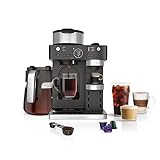
- BARISTA PLUS TECHNOLOGY: The 19-bar pressure system delivers ultra-flavorful espresso with a silky-smooth crema by brewing at the optimal temperature and pressure.
- COFFEEHOUSE DRINKS AT HOME: The built-in, fold-away frother allows you to create espresso-based cappuccinos, lattes, flat whites, and more.
- BREW SINGLE-SERVE ESPRESSO: Choose your favorite espresso capsule and brew up to 3 styles: Espresso (1.35 oz), Lungo (3.75 oz), and Over Ice (1 oz).
- BREW THROUGH COFFEE GROUNDS: Make a Classic, Rich, or Over Ice brew. Select 9 different sizes ranging from cup, to travel mug, to a full 12-cup carafe.
- VERSATILITY TO ENTERTAIN: Treat your guests to an espresso-based coffeehouse drink or brew a 12-cup carafe for the crowd.
How to choose step-by-step
Step 1: Assess your daily coffee needs
- What to do: Think about how many cups of coffee you and your household drink daily. Do you usually have one cup or a full pot?
- What “good” looks like: You’ve got a clear number in mind, say “4 cups on weekdays, 8 on weekends.”
- A common mistake and how to avoid it: Guessing. If you’re unsure, start by tracking your coffee consumption for a week. Better to overestimate slightly than buy a machine that’s too small.
Step 2: Identify desired brew styles
- What to do: List all the ways you like your coffee. Just black? Iced coffee? Lattes?
- What “good” looks like: You know you want hot coffee, maybe iced coffee, and you’re curious about a built-in frother.
- A common mistake and how to avoid it: Forgetting about iced coffee. Ninja’s “over ice” brew is a big selling point for many. If you drink iced coffee, make sure the machine handles it well.
Step 3: Determine your space limitations
- What to do: Measure the counter space where the coffee maker will live. Consider height under cabinets too.
- What “good” looks like: You have precise measurements (e.g., 15 inches wide, 12 inches deep, 18 inches high).
- A common mistake and how to avoid it: Not measuring. You might buy a great machine only to find it doesn’t fit. Always measure twice, buy once.
Step 4: Consider cleaning convenience
- What to do: Think about how much time you’re willing to spend cleaning. Do you want dishwasher-safe parts?
- What “good” looks like: You prioritize removable, dishwasher-safe components for quick cleanup.
- A common mistake and how to avoid it: Underestimating cleaning. A machine with many nooks and crannies can become a chore. Look for simple designs.
Step 5: Set your budget range
- What to do: Decide on a realistic price range you’re willing to spend.
- What “good” looks like: You have a clear upper limit, like “$150 max.”
- A common mistake and how to avoid it: Not budgeting. You might fall in love with a high-end model you can’t afford. Stick to your numbers.
Step 6: Research specific Ninja models
- What to do: Now that you know your needs, start looking at Ninja models that fit. Read reviews.
- What “good” looks like: You’ve narrowed it down to 2-3 models that meet your criteria and have positive user feedback.
- A common mistake and how to avoid it: Buying the first one you see. Take time to compare features and prices across different Ninja lines.
Step 7: Check for deals and bundles
- What to do: Look for sales, especially during major shopping holidays or on retailer websites.
- What “good” looks like: You snag a model you like at a discounted price.
- A common mistake and how to avoid it: Paying full price without checking for sales. Patience can save you a good chunk of change.
Common mistakes (and what happens if you ignore them)
| Mistake | What it causes | Fix |
|---|---|---|
| Buying a machine too small for your needs | Running out of coffee, having to brew multiple times, frustration. | Track your coffee consumption for a week before buying. |
| Ignoring the “Over Ice” feature if you like iced coffee | Weak, watered-down iced coffee. | Ensure the machine has a dedicated “Over Ice” brew setting if this is important to you. |
| Not measuring your counter space | The machine doesn’t fit under cabinets or is too wide for the spot. | Measure your intended coffee maker location thoroughly, including height. |
| Assuming all carafes keep coffee hot | Coffee cools down too quickly, requiring reheating. | Opt for a thermal carafe if you often let coffee sit. |
| Overlooking cleaning requirements | Mold growth, poor-tasting coffee, and a generally unsanitary appliance. | Choose models with removable, dishwasher-safe parts and simple designs. |
| Forgetting to budget for filters (if applicable) | Unexpected extra costs, or using a non-ideal filter. | Check if the model uses a permanent filter or requires disposable ones and factor that into your budget. |
| Relying solely on advertised brew times | Actual brew time can be longer, especially for full pots. | Read user reviews for real-world brew time experiences. |
| Not checking the warranty period | You’re on the hook for repairs shortly after purchase. | Look for models with at least a 1-year warranty. |
| Buying a machine with too many complex features you won’t use | Higher cost, potential for more things to break, and unnecessary complexity. | Stick to the features you actually need and will use regularly. |
| Not considering noise levels | Waking up others in the household or being disruptive. | Check reviews for comments on how loud the machine is during operation. |
Decision rules (simple if/then)
- If you drink more than 6 cups of coffee per day, then choose a Ninja coffee maker with a 10-12 cup carafe capacity because smaller machines will require multiple brews.
- If you frequently make iced coffee, then select a model with a dedicated “Over Ice” brew setting because it brews a concentrated hot coffee that rapidly chills, preventing dilution.
- If you have limited counter space, then look for Ninja’s more compact models or those with a smaller footprint because larger machines can overwhelm a small kitchen.
- If you prefer a hot cup of coffee hours after brewing, then opt for a Ninja with a thermal carafe because it maintains temperature without a warming plate, which can scorch coffee.
- If ease of cleaning is paramount, then prioritize models with removable, dishwasher-safe components like the brew basket and carafe because this significantly speeds up daily cleanup.
- If you enjoy specialty coffee drinks like lattes and cappuccinos, then consider a Ninja model that includes a built-in milk frother because this feature eliminates the need for a separate appliance.
- If you want coffee ready the moment you wake up, then ensure the model has a programmable auto-start timer because this allows you to set it the night before.
- If you’re on a tight budget, then focus on Ninja’s entry-level models which offer core brewing functionality without advanced features because these are typically the most affordable.
- If you’re unsure about a specific model’s performance, then read multiple user reviews and watch video demonstrations because this provides real-world insights beyond marketing materials.
- If you plan to brew single cups frequently, then look for a Ninja coffee maker that explicitly supports single-serve brewing in addition to carafes because not all multi-function machines do this well.
- If you’re concerned about coffee quality and extraction, then investigate models that offer adjustable brew temperatures or strength settings because these allow for more control over the final taste.
FAQ
How much does a basic Ninja coffee maker typically cost?
You can find entry-level Ninja coffee makers for around $70-$100. These usually cover the essentials like brewing a carafe or single cups.
What’s the price range for Ninja coffee makers with more advanced features?
Models with features like frothers, multiple brew styles (including over ice), and advanced temperature control can range from $120 to over $200.
Are Ninja coffee makers generally expensive compared to other brands?
Ninja offers a wide range, so prices can be comparable. They often provide a good balance of features for their price point, especially in the mid-range.
Does the price increase significantly for models that brew different types of coffee?
Yes, models that offer specialty brews, iced coffee, or single-serve options usually cost more than basic drip coffee makers.
Should I factor in the cost of filters when calculating the total price?
Most Ninja coffee makers come with a reusable filter, so ongoing filter costs are minimal. However, if you prefer paper filters, factor those in.
Where can I find the best deals on Ninja coffee makers?
Keep an eye on major online retailers, department store sales, and during holiday shopping events like Black Friday.
Is it worth paying more for a Ninja coffee maker with a thermal carafe?
If you often leave coffee sitting for a while, a thermal carafe is worth it. It keeps coffee hot for hours without the need for a warming plate, which can affect taste.
What does “Ninja’s signature brew” mean, and does it affect price?
This usually refers to Ninja’s proprietary brewing technology designed for optimal flavor extraction. While it’s a feature, it doesn’t always mean a drastically higher price point compared to other features.
Are there any hidden costs associated with Ninja coffee makers?
Generally, no. The main ongoing cost is coffee beans or grounds. Some specialty models might have accessories that could be purchased separately.
What this page does NOT cover (and where to go next)
- Specific, up-to-the-minute pricing for every single Ninja model (prices fluctuate, check retailers).
- Detailed technical specifications or comparisons of every single Ninja model variant.
- Reviews of specific coffee beans or grind sizes that pair best with Ninja coffee makers.
- Comparisons of Ninja coffee makers to other brands (e.g., Cuisinart, Keurig, Breville).
- Maintenance tips beyond basic cleaning (e.g., descaling procedures for specific models).
- Information on how to troubleshoot complex electrical or mechanical issues with a Ninja coffee maker.