
Evaluating the Value of a Pour Over Coffee Maker
Quick Answer: Is a Pour Over Coffee Maker Worth It?
- Yeah, a pour over coffee maker can be totally worth it if you dig nuanced flavor and enjoy the ritual.
- It’s for folks who want control over their brew and aren’t afraid of a little hands-on effort.
- You’ll get a cleaner, brighter cup compared to many other methods.
- The initial cost is usually low, but good beans and a grinder add up.
- It’s a pretty simple setup, so cleaning is usually a breeze.
- If you’re all about speed and convenience, maybe look elsewhere.
If you’re looking to get started with this method, a good pour over coffee maker is an excellent investment for a cleaner, brighter cup.

- Pour Over Coffee: Manual Pour Over Coffee Maker allows you to brew an excellent cup of Coffee in minutes
- Stainless steel: Includes a new and improved permanent, stainless steel mesh filter that helps extract your coffee's aromatic oils and subtle flavors instead of being absorbed by a paper filter
- Coffee Carafe: Made of durable, heat-resistant borosilicate glass with Cork Band detailing that is both functional and elegant; single wall
- Quick and Easy: Simply add coarse ground Coffee to filter, pour a small amount of water in a circular motion over ground Coffee until soaked then add the remaining water and let drip
- Servings: Pour Over Coffee Maker makes 8 cups of Coffee, 4 oz each; dishwasher safe
Buying Priorities for Your Pour Over
- Material: Ceramic, glass, stainless steel, or plastic. Ceramic and glass hold heat well but can break. Stainless steel is durable but can be pricier. Plastic is cheap but some folks worry about taste.
- Size/Capacity: How much coffee do you usually make? Most pour overs are single-cup or small batches (1-2 cups). Big families might need something else.
- Design/Flow Rate: Some drippers have specific ridges or hole sizes that affect how fast the water flows through. This impacts extraction. Simpler is often better to start.
- Filter Type: Paper filters are common, offering a clean cup but adding ongoing cost and waste. Metal filters let more oils through, giving a fuller body but can be harder to clean.
- Ease of Cleaning: Most are simple. Just toss the grounds and rinse. But some designs might have nooks and crannies.
- Durability: How well is it built? If you’re rough on your gear, a sturdy stainless steel or thick ceramic might be the way to go.
- Portability: Planning to take it camping or to the office? A lightweight plastic or metal one is your friend.
- Aesthetics: Let’s be honest, it’s going to sit on your counter. Does it look good to you?
When choosing your coffee dripper, consider materials like ceramic or glass for heat retention, or stainless steel for durability.
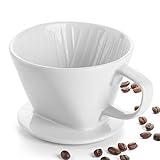
- Portable Handmade Brew - DOWAN ceramic pour-over coffee dripper lets you have a traditional, hands-on brewing experience. You can have a cup or two of coffee whenever and wherever you want, without the help of a machine.
- Three holes Dripping Design - The unique three-hole drip design makes the coffee flow more concentrated, and ensures the proper brewing time to fully extract the coffee flavor.
- Thoughtful Design - The V-shaped conical design can make the coffee powder pile higher, thereby prolonging the contact time with water and making it easy to fully infuse the coffee.
- Inner Wall Vertical Rib - The inner wall of this coffee pour over adopts a vertical groove design, and the distance between the filter paper and the wall of the filter cup is reserved to fully extract the coffee essence. (filter paper is NOT included)
- High Quality Material: The pour-over coffee maker is made of high-fired ceramic, with good heat preservation and durability. This coffee dripper can greatly prevents heat loss than wire mesh filter during brewing, fit for most mugs and thermoses.
Pour Over Coffee Maker Feature Comparison
- Brew Method: Manual drip. You control water flow and temperature.
- Capacity: Typically 1-2 cups (8-16 oz) per brew cycle. Larger carafes are available with some systems.
- Temperature Control: Not built-in. You need a kettle with temperature control or a thermometer to get it right. Aim for 195-205°F.
- Filter Type: Most use #2 or #4 cone or basket-style paper filters. Reusable metal or cloth filters are also an option.
- Cleaning: Generally very easy. Dispose of used grounds and filter, rinse the dripper. Metal filters might need a scrub.
- Footprint: Small. Most drippers are compact and don’t take up much counter space.
- Material Options: Ceramic, glass, stainless steel, plastic, copper.
- Grind Size: Medium to medium-fine. Consistency is key.
- Water Flow Control: Entirely manual. Your pouring technique dictates this.
- Extraction Control: High. You manage water temp, pour speed, and bloom time.
- Flavor Profile: Known for bright, clean, nuanced cups highlighting origin flavors.
- Durability: Varies by material. Glass and ceramic are breakable; metal and plastic are more robust.
How to Choose a Pour Over Coffee Maker Step-by-Step
1. Figure out your coffee needs.
- What to do: Decide if you’re brewing for one, two, or a small crew.
- What “good” looks like: You’ve got a clear idea of how many cups you’ll make at once. For most, 1-2 cups is plenty.
- Common mistake: Buying a tiny single-cup dripper when you sometimes make coffee for your partner. Avoid this by considering your occasional needs too.
2. Consider your budget.
- What to do: Set a realistic price range for the dripper itself.
- What “good” looks like: You know you can afford the dripper plus the essential accessories (kettle, grinder, filters). Drippers themselves can range from $10 to $100+.
- Common mistake: Forgetting that a good grinder and a gooseneck kettle are almost as important as the dripper itself. Don’t blow your whole budget on just the brewer.
3. Pick your material.
- What to do: Think about what material best suits your lifestyle and preferences.
- What “good” looks like: You’ve chosen ceramic for heat retention, glass for seeing the brew, stainless steel for durability, or plastic for portability/affordability.
- Common mistake: Going for the cheapest plastic option without considering if it might impart a taste or feel flimsy.
For a visually appealing and heat-retaining option, a glass coffee dripper is a fantastic choice that allows you to see the brewing process.

- 🏆 | Combines the Best of Pour Over and French Press Coffee with its Patented Release Valve
- ✅ | Includes | Clever Dripper, 100 Clever Filters, Coaster and Lid
- ☕ | No Mess, Easy to Use and Clean | 1) Add Filter, Hot water, Groud Coffee 2) Let steep 3) Place on mug to dispense 4) Toss Filter and Rinse Dripper. -> Enjoy your morning brew!
- ☕ | Large Size| Holds 18 oz. - Fit on cups and thermoses with tops wider than 1.5" and less than 3.75" in diameter.
- 💖 | Perfect cup every time! | Immersion brewing lets you decide how long to brew for to make your Perfect Cup!
4. Decide on the filter type.
- What to do: Choose between paper, metal, or cloth filters.
- What “good” looks like: You understand the trade-offs: paper for clean cups and ease, metal for body and reusability, cloth for a unique texture.
- Common mistake: Not realizing paper filters are a recurring cost and create waste. If that’s a dealbreaker, factor in a reusable filter from the start.
5. Check the dripper design.
- What to do: Look at the shape and any unique features of the dripper.
- What “good” looks like: You’ve picked a design that appeals to you and seems straightforward to use. Classic cone shapes are user-friendly.
- Common mistake: Getting mesmerized by overly complex designs that promise magic but are just harder to master for a beginner. Keep it simple at first.
6. Assess cleaning and maintenance.
- What to do: Think about how easy it will be to clean after each use.
- What “good” looks like: The dripper has few parts and is easy to rinse.
- Common mistake: Buying a dripper with a lot of intricate parts or a design that traps grounds, making cleanup a chore.
7. Factor in accessories.
- What to do: Identify what else you’ll need.
- What “good” looks like: You’ve accounted for a gooseneck kettle, a burr grinder, and maybe a scale.
- Common mistake: Thinking you can use any old kettle and grinder. A gooseneck kettle gives control, and a burr grinder provides consistent particle size, crucial for pour over.
8. Read reviews.
- What to do: See what other users are saying about specific models.
- What “good” looks like: You’ve found common praise for ease of use, durability, or flavor results.
- Common mistake: Relying solely on marketing hype. Real-world experiences are gold.
Common Mistakes (and What Happens If You Ignore Them)
| Mistake | What it causes | Fix |
|---|---|---|
| Using pre-ground coffee | Inconsistent extraction, stale flavor, lack of aroma | Grind beans fresh, right before brewing. |
| Wrong grind size (too fine or too coarse) | Too fine: bitter, clogged filter. Too coarse: weak, sour, watery coffee. | Use a burr grinder and aim for medium-fine, like table salt. Adjust based on taste. |
| Water not hot enough (below 195°F) | Under-extraction, sour, weak coffee | Use a thermometer or temperature-controlled kettle. Aim for 195-205°F. |
| Water too hot (above 205°F) | Over-extraction, bitter, burnt taste | Let boiling water sit for 30-60 seconds, or use a temp-controlled kettle. |
| Uneven pouring or water distribution | Channeling (water bypasses grounds), uneven extraction, weak or bitter spots | Pour in slow, controlled concentric circles, wetting all grounds evenly. Use a gooseneck kettle. |
| Not blooming the coffee | CO2 trapped in grounds, leading to uneven extraction and gassy brew | Pour just enough hot water to saturate grounds and let it sit for 30 seconds (the bloom). |
| Using old or stale coffee beans | Flat, lifeless flavor, lack of aroma | Buy fresh, whole beans and store them in an airtight container away from light and heat. |
| Not rinsing paper filters | Papery taste in the coffee | Rinse paper filters with hot water before adding grounds to remove any paper residue. |
| Not cleaning the dripper regularly | Stale oils can build up and affect future brews | Rinse the dripper thoroughly after each use. Deep clean periodically if needed. |
| Not using a scale for coffee and water | Inconsistent brew ratios, making it hard to replicate good results | Use a digital scale to measure coffee grounds and water for precise and repeatable brewing. |
Decision Rules (Simple If/Then)
- If you prioritize speed and simplicity, then a pour over coffee maker might not be the best fit because its manual nature takes time.
- If you enjoy the process of making coffee and want to experiment with flavor, then a pour over coffee maker is likely worth it because it offers a high degree of control.
- If you want the cleanest, brightest cup possible, then a pour over with paper filters is a good choice because paper filters trap oils and sediment.
- If you prefer a fuller-bodied coffee and want to reduce waste, then consider a pour over with a metal filter because it allows more oils to pass through.
- If you’re on a tight budget for initial setup, then a plastic pour over dripper is a good starting point because they are very inexpensive, but be aware of potential taste impact.
- If you travel frequently or camp, then a durable, lightweight plastic or stainless steel pour over is ideal because it’s less likely to break and easy to pack.
- If you want to replicate a perfect cup consistently, then investing in a burr grinder and a digital scale alongside your pour over is essential because they ensure precise measurements and particle size.
- If you have a large household and need to make coffee for many people at once, then a pour over coffee maker might be impractical because most are designed for single servings or small batches.
- If you are concerned about breaking delicate materials, then a ceramic or glass pour over might require more careful handling than a stainless steel or plastic option.
- If you want to taste the subtle nuances of single-origin coffees, then a pour over coffee maker is an excellent tool because it highlights these delicate flavors better than many other brewing methods.
- If you’re new to coffee brewing and want to learn the fundamentals, then a pour over is a great teacher because it forces you to pay attention to variables like grind size, water temperature, and pour rate.
FAQ
- Is a pour over coffee maker hard to use?
Not really, once you get the hang of it. The basic steps are simple: heat water, grind beans, add grounds, bloom, and pour. It just takes a little practice to refine your pouring technique.
- Do I need a special kettle for pour over?
A gooseneck kettle is highly recommended. Its long, narrow spout gives you much better control over the water flow, which is crucial for even extraction. You can get by without one, but it makes life harder.
- What kind of coffee beans are best for pour over?
Lighter to medium roasts often shine in pour over because the method highlights their delicate aromatics and brighter acidity. Single-origin beans are also a great choice to really taste what the coffee offers.
- Can I make iced coffee with a pour over?
Absolutely. You can brew directly over ice, or brew a concentrated batch and pour it over ice. This is a fantastic way to get a clean, flavorful iced coffee without the bitterness sometimes found in other methods.
- How much coffee grounds and water should I use?
A good starting point is a ratio of 1:15 to 1:17 (coffee to water by weight). So, for 20 grams of coffee, you’d use about 300-340 grams (or ml) of water. Use a scale for best results.
- Does the pour over method make bitter coffee?
Generally, no. If your pour over is bitter, it’s usually a sign of over-extraction, often caused by too fine a grind, water that’s too hot, or pouring too quickly. Adjusting these factors usually fixes bitterness.
- What’s the difference between a cone dripper and a flat-bottom dripper?
Cone drippers (like Hario V60) often have a spiral ribbing and a large hole, allowing for more control over flow rate and extraction. Flat-bottom drippers (like Kalita Wave) have three small holes and are generally more forgiving and consistent.
What This Page Does Not Cover (and Where to Go Next)
- Specific brand comparisons and reviews. Look for detailed product reviews online from coffee enthusiasts.
- Advanced pour over techniques like pulse pouring or specific agitation methods. Explore dedicated brewing guides for these.
- The science behind coffee extraction and solubility. Dive into coffee science resources for a deeper understanding.
- Recipes for coffee-based drinks using pour over as a base. Search for barista recipe books or online coffee communities.
- Detailed comparisons with espresso or cold brew methods. These are different beasts altogether, so check out pages dedicated to those brewing styles.