
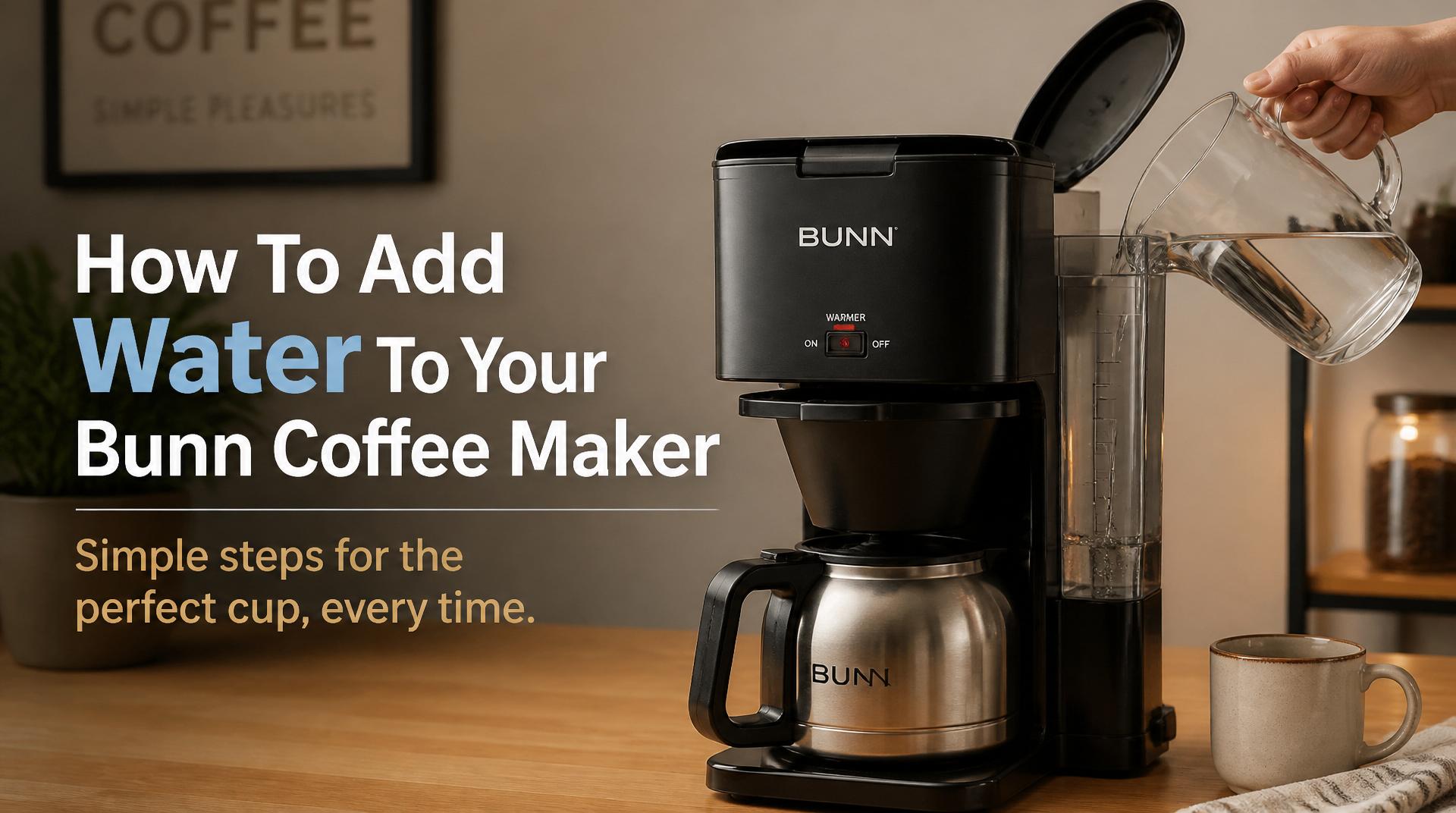
How To Add Water To Your Bunn Coffee Maker
How to Add Water to Your Bunn Coffee Maker – A Simple Guide
Bunn coffee makers are known for brewing a pot in under four minutes, largely thanks to their internal hot water tank. One of the most common questions new owners have is how to add water correctly. The process is straightforward, but doing it right can affect both your coffee’s taste and the machine’s longevity. Whether you have a classic home model like the Bunn Velocity Brew or a commercial unit, here’s everything you need to know about filling it with water – and a few recommendations if you’re considering a change.
Step-by-Step: Adding Water to Your Bunn
Bunn machines come in two main designs: those where you pour water into the reservoir at the top (common on home models) and commercial-style machines with a fixed water line. For most home brewers, the process is:
Related: More coffee maker usage guides and tips.
- Remove the carafe – This activates a safety switch that stops water flow.
- Lift the lid or open the swing-top – Pour fresh, cold tap water (or filtered water) into the reservoir. Avoid using distilled water, as it can affect the machine’s sensors and taste.
- Fill to the desired level – Bunn reservoirs have internal markings for cups (usually 4 to 10). The carafe itself can also be used as a measuring cup: fill it with water and pour it in.
- Replace the carafe – The machine will heat the water and be ready to brew in about 15 minutes (if it was empty).
- Brew instantly – Once the water is hot, adding fresh grounds and pressing the brew button (on some models) produces coffee almost immediately.
If you find the top-loading design of some Bunn models a bit fiddly, you might appreciate a machine with a removable water reservoir. The APOXCON Automatic Drip Coffee Maker features a glass water tank that’s easy to fill at the sink, plus a built-in scale that tells you exactly how much water you’re using – handy for replicating a pour-over style at the touch of a button.
Common Mistakes When Adding Water
Even simple tasks have pitfalls. Here’s what to avoid with your Bunn:
- Overfilling – The reservoir expands when the water heats up. Exceeding the max line can cause overflow, especially on models with a spray head.
- Using hot water – Always start with cold water. Bunn machines heat their own water, and hot tap water can bring minerals or sediment that affects taste and scale buildup.
- Not priming a new machine – When you first set up a Bunn, you need to run a full cycle of water (no coffee) to fill the internal tank. Some models require two or three cycles to stabilise temperature.
- Ignoring water quality – Hard water leads to scale that clogs the spray head. Use filtered water if your tap is hard, and descale every three months.
If you prefer not to worry about water lines or descaling schedules, consider a single-serve machine that handles smaller volumes at once. The Chefman Caffeinator Single Serve Coffee Maker has a generous 45 oz. removable water reservoir that’s easy to fill and clean. It also offers brew strength settings and an iced coffee function – so you’re not limited to hot coffee only.
Maintaining Your Water System
To keep your Bunn brewing great coffee, take care of its water path:
- Empty the carafe after brewing – Don’t let coffee sit on the hot plate for hours; it tastes burnt and can stain the glass.
- Wipe the spray head – Mineral deposits can clog the small holes. Use a paper towel moistened with vinegar to clean it monthly.
- Descale regularly – Use a descaling solution or a 50/50 white vinegar and water mix, run through a full cycle, then two cycles of plain water to rinse.
- Replace the water filter (if applicable) – Some Bunn models have a built-in charcoal filter. Change it every two months for best flavor.
For those who want a machine that takes the guesswork out of water maintenance, the Tastyle Single Serve Coffee Maker is a compact option with a 40 oz. removable tank and a clear water window. It supports both K-Cups and ground coffee, and its 6–24 oz brew sizes make it versatile for a single cup or a travel mug up to 7.3 inches tall.
When Your Bunn Feels Like a Relic
Bunn machines are built to last, but they lack some modern conveniences: no programmable timer, no warm-up delay, and no auto-shutoff on many models. If you’re tired of manually filling the tank every morning or want more control over brew strength, you might consider switching to a newer drip machine.
The BLACK+DECKER 12-Cup Digital Coffee Maker offers programmable timer, a clear water window, and a Sneak-A-Cup feature that pauses brewing so you can pour a quick cup without dripping. It’s a workhorse for households that want a full pot with minimal effort – and the water window means you’ll never accidentally overfill.
If you’re the type who switches between a single mug and a full carafe depending on the day, a dual-mode machine like the Tastyle Hot & Iced Coffee Maker with Magnetic K-Pod Organizer could be a great fit. It brews 4–5 cups as a drip machine or a single serving with K-Cups, and its 40 oz. removable water tank is easy to fill at the sink. The built-in magnetic pod holder, however, is what sets it apart – it stores up to 10 pods so you don’t have to dig through a drawer every morning.
Final Thoughts
Adding water to a Bunn coffee maker is a simple ritual once you know the basics: cold water, correct fill level, and regular descaling. The machine rewards you with speed and consistent temperature. But if you find yourself wishing for a more flexible water system – or you just want a machine that fits your current coffee habits better – the market offers plenty of well-designed alternatives that make water management effortless. Choose a brewer that matches your volume, your preferred brew strength, and your morning routine.