
Using K-Cups In A Standard Coffee Maker: What You Need To Know
Quick answer
- K-Cups are designed for single-serve Keurig brewers, not standard drip coffee makers.
- You generally cannot use a whole K-Cup directly in a regular coffee maker.
- The most common method is to open the K-Cup and use the coffee grounds inside.
- This approach may not yield optimal results due to grind size and coffee quantity differences.
- Reusable K-Cup adapters or pods are available for some Keurig machines, but not for standard brewers.
- For best results, use coffee specifically ground and portioned for your standard coffee maker.
What this problem usually is (and is not)
- This problem is usually about trying to adapt a convenient single-serve format to a different brewing system.
- It is often about maximizing existing supplies or exploring cost-saving options.
- It is NOT about making coffee unsafely if you extract the grounds from the K-Cup.
- It is NOT about damaging your standard coffee maker by adding a K-Cup directly.
- It is NOT a recommended method for achieving high-quality coffee.
- It is NOT a way to convert your drip coffee maker into a Keurig-style machine.
Likely causes (triage list)
- Misunderstanding K-Cup design: K-Cups are sealed pods with specific dimensions and puncture points, not just bags of coffee.
- How to confirm: Examine a K-Cup; note the foil lid and plastic cup structure.
- Lack of appropriate coffee: You might only have K-Cups on hand and no ground coffee for your drip maker.
- How to confirm: Check your pantry for other coffee options.
- Desire for convenience: K-Cups are designed for speed, which might be appealing even for a standard brewer.
- How to confirm: Consider why you want to use a K-Cup instead of traditional grounds.
- Incorrect grind size expectation: K-Cup coffee is often ground for quick extraction in a Keurig, which might be too fine for a drip machine.
- How to confirm: Compare the texture of K-Cup grounds to typical drip coffee grounds.
- Portion size mismatch: A single K-Cup contains enough coffee for one small serving, not usually a full pot.
- How to confirm: Check the weight of coffee in a K-Cup (often around 9-12 grams) versus what your drip maker requires (e.g., 60-70 grams for 10 cups).
- Filter compatibility issues: The coffee from a K-Cup needs a standard filter, not the K-Cup itself.
- How to confirm: Observe if the K-Cup grounds are too fine for your existing paper or permanent filter, potentially leading to sediment.
If you’re in a pinch and only have K-Cups on hand, you can carefully open them to use the coffee grounds in your standard maker. Just be sure to use grounds from a K-Cup coffee product like this one.
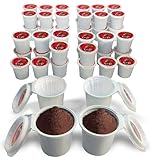
- Finally, You Can Brew Coffeehouse Quality in Your K Cup Brewers - iFillCup has been selected by hundreds of premiere coffee roasters and won multipe Gold medals in GoldenBean competitions worldwide (see videos). Our Patented DeepBrew Filter allows you to fill up to 50% more of your favorite coffee, enabling you to make an insanely rich brew or brew two 8-OZ cups or one 16-OZ rich Mug for your morning commute with a single pod. This is not possible with any other pods.
- Make Your Own K Cups in Seconds – Just add your favorite fresh coffee and flip the lid closed. Make dozens in minutes at your leisure. The air-proof pod will preserve freshness for months.
- Save $Hundreds A Year - One pound of your favorite coffee can fill up to 48 iFillCup pods. Choose the 96 or 288-Cont to Save more. Perfect to share with your family and friends.
- Universal Compatibility - iFillCup is compatible with all Keurig brewers including 1.0, 2.0, K-Supreme and other k cup brewers (except Ninja), as tested by our Washington Advanced Coffee Lab and 300+ Specialty Coffee companies worldwide that have selected iFillCup for their artisan coffee.
- 100% Risk-Free – Since 1993 we’ve promised to provide the coffee world with the most rugged and innovative products. We offer you a 100% satisfaction guarantee. Our warm Washougal, WA Customer Care team will always be happy to answer your calls or emails.
Fix it step-by-step (brew workflow)
1. Gather your supplies: You’ll need a K-Cup, a pair of scissors or a knife, your standard coffee maker, a filter, and water.
- What good looks like: All items are clean and readily accessible.
- Common mistake: Using a dull tool to open the K-Cup, which can make it messy. Use a sharp pair of scissors or a knife carefully.
2. Open the K-Cup: Carefully peel back or cut the foil lid off the K-Cup.
- What good looks like: The K-Cup is open, revealing the coffee grounds inside, without spilling.
- Common mistake: Ripping the foil haphazardly, potentially spilling grounds or tearing the filter inside the K-Cup. Be gentle.
3. Extract the grounds: Gently tap or spoon the coffee grounds from the K-Cup into your coffee maker’s filter basket.
- What good looks like: All the coffee grounds are transferred to the filter, leaving the K-Cup empty.
- Common mistake: Leaving some grounds behind in the K-Cup, reducing the coffee strength. Ensure a complete transfer.
4. Add a standard filter: Place a paper filter (or your permanent filter) into the coffee maker’s brew basket as you normally would.
- What good looks like: The filter is correctly seated in the basket, ready to hold the grounds.
- Common mistake: Forgetting the filter, which will result in coffee grounds in your brewed coffee. Always use a filter.
5. Distribute the grounds: Gently shake the filter basket to evenly distribute the K-Cup grounds.
- What good looks like: The coffee grounds form a relatively flat bed in the filter.
- Common mistake: Leaving the grounds mounded, which can lead to uneven extraction. A flat bed promotes better brewing.
6. Add water: Fill your coffee maker’s water reservoir with fresh, cold water.
- What good looks like: Water is filled to the desired level, typically for a single serving or two, given the amount of coffee from one K-Cup.
- Common mistake: Adding too much water for the small amount of coffee, resulting in very weak coffee. Use less water than you would for a full pot.
7. Start brewing: Initiate the brewing cycle on your standard coffee maker.
- What good looks like: The coffee maker begins its normal brewing process.
- Common mistake: Expecting the brew time to be the same as a Keurig; it will be longer. Allow the machine to complete its cycle.
8. Serve and enjoy: Once brewing is complete, pour your coffee into a mug.
- What good looks like: You have a cup of brewed coffee, albeit potentially weaker or with more sediment than usual.
- Common mistake: Expecting the same flavor profile as a Keurig-brewed cup. The different brewing methods will yield different results.
When you extract the grounds from a K-Cup, you’ll still need a standard filter. Having a pack of disposable coffee filters on hand ensures you can brew without issue.
No products found.
Prevent it next time
- Regular cleaning and descaling: Keep your coffee maker clean to ensure optimal performance, regardless of coffee source.
- Water quality and storage: Always use fresh, filtered water for brewing and store K-Cups in a cool, dry place.
- Correct ratio and grind: For standard coffee makers, aim for about 2 tablespoons (10-12 grams) of medium-ground coffee per 6 ounces of water. K-Cup grounds might be too fine.
- Proper filter use: Always use the correct size and type of filter for your coffee maker to prevent sediment and ensure proper flow.
- Basic safety checks: Ensure your coffee maker is on a stable surface and its cord is in good condition before brewing.
- Stock appropriate coffee: Keep a supply of pre-ground or whole bean coffee suitable for your standard coffee maker.
- Consider a grinder: If you use whole beans, grinding them fresh and to the correct consistency will significantly improve your coffee.
- Evaluate coffee needs: Determine if a single-serve brewer or a standard drip maker best suits your daily coffee habits.
Common mistakes (and what happens if you ignore them)
| Mistake | What it causes | Fix |
|---|---|---|
| Trying to place a whole K-Cup in the filter basket | Will not fit, obstructs water flow, no coffee brewed. | Open the K-Cup and use only the grounds. |
| Not using a paper or permanent filter | Coffee grounds will end up in your brewed coffee. | Always use the correct filter for your drip machine. |
| Using too much water for one K-Cup’s grounds | Very weak, watery coffee with little flavor. | Reduce water amount; one K-Cup is for one small serving (6-8 oz). |
| Expecting a full pot from one K-Cup | Insufficient coffee for more than 1-2 small cups. | Use multiple K-Cups or switch to regular ground coffee for a pot. |
| Ignoring the fine grind of K-Cup coffee | Potential for over-extraction (bitterness) or sediment in the cup. | Accept the potential flavor difference or use a finer filter. |
| Not distributing grounds evenly | Uneven extraction, leading to some weak and some bitter coffee. | Gently shake the filter basket to level the grounds. |
| Leaving the K-Cup filter in with the grounds | Can impede water flow, or add an unwanted papery taste. | Discard the K-Cup’s internal filter; use your machine’s filter. |
| Assuming K-Cup coffee is always fresh | K-Cups have a shelf life; old coffee can taste stale. | Check the expiration date on the K-Cup for optimal flavor. |
| Not cleaning the coffee maker after use | Residue buildup can affect flavor and machine lifespan. | Rinse the filter basket and carafe after each use; descale regularly. |
| Using K-Cup grounds as a regular habit | Can be more expensive and less flavorful than bulk ground coffee. | Purchase coffee specifically for your drip machine for better value and taste. |
Decision rules (simple if/then)
- If you only have K-Cups and need coffee immediately, then open the K-Cup and use the grounds because it’s the only way to adapt it.
- If you want a full pot of coffee, then do not use a single K-Cup because it contains enough grounds for only one small serving.
- If you are concerned about coffee quality, then do not use K-Cup grounds in a standard coffee maker because the grind size and freshness may not be ideal.
- If you frequently run out of drip coffee grounds, then buy a supply of suitable ground coffee because relying on K-Cups for a drip maker is inefficient.
- If you prefer the convenience of single-serve, then consider investing in a Keurig brewer because K-Cups are designed for that system.
- If your brewed coffee tastes weak, then reduce the amount of water you are using because K-Cup grounds are portioned for a small cup.
- If you find sediment in your coffee, then ensure your drip coffee maker’s filter is properly seated and the correct type because K-Cup grounds can be fine.
- If you are trying to save money, then buy bulk ground coffee instead of K-Cups because it is generally more cost-effective for a standard brewer.
- If you want the best possible flavor from your standard coffee maker, then use freshly ground coffee appropriate for drip brewing because K-Cup grounds are a compromise.
FAQ
Can I just put a whole K-Cup into my drip coffee maker?
No, a whole K-Cup is not designed to fit or function in a standard drip coffee maker. It’s a sealed pod that requires a Keurig machine to puncture and brew. Trying to force it in could damage your machine or simply yield no coffee.
Will the coffee taste the same if I use K-Cup grounds in my regular coffee maker?
Likely not. The grind size of K-Cup coffee is optimized for Keurig machines, which use pressure and quick extraction. In a drip machine, this grind might lead to over-extraction (bitterness) or simply a different flavor profile due to the longer brew time and different water contact.
How much coffee is in one K-Cup?
Typically, a standard K-Cup contains about 9-12 grams (0.32-0.42 ounces) of coffee grounds. This is usually enough for a single 6-8 ounce serving of coffee, not a full pot.
Is it safe to open a K-Cup and use the grounds?
Yes, it is generally safe to open a K-Cup and use the coffee grounds inside. Just be careful when cutting the foil lid. The coffee itself is regular ground coffee.
What’s the ideal water-to-coffee ratio for a standard coffee maker?
A common recommendation is 2 tablespoons (about 10-12 grams) of coffee for every 6 ounces of water. Adjust to your personal taste. K-Cup grounds will require less water than this ratio for a single cup.
Can using K-Cup grounds damage my standard coffee maker?
No, simply using the grounds from a K-Cup in your standard coffee maker’s filter basket will not damage the machine. The grounds are no different from regular ground coffee in that regard.
What this page does NOT cover (and where to go next)
- Specific Keurig machine models or their maintenance.
- Detailed comparisons of coffee bean types or roasts.
- Advanced coffee brewing techniques like pour-over or espresso.
- How to properly store large quantities of bulk coffee beans.
- Environmental impact of K-Cups versus other coffee formats.