
Coffee Shop Economics: Monthly Revenue Insights
Quick answer
- Coffee shops can bring in anywhere from $10,000 to $50,000+ per month.
- Location is a huge factor, no doubt.
- Your menu mix matters. Espresso drinks usually pull more profit than drip.
- Staffing and overhead can eat into profits fast.
- Loyalty programs and events can boost that monthly take.
- It’s a grind, but it can pay off.
Key terms and definitions
- Gross Revenue: The total money earned before any expenses are taken out.
- Net Profit: What’s left after all business expenses are paid. This is the real money in your pocket.
- Cost of Goods Sold (COGS): The direct costs tied to making your products – beans, milk, cups, syrups.
- Operating Expenses: All the other costs of running the shop: rent, utilities, wages, marketing.
- Average Ticket Size: The average amount each customer spends per visit.
- Foot Traffic: The number of people walking by or entering your shop.
- Customer Acquisition Cost (CAC): How much it costs to get a new customer in the door.
- Customer Lifetime Value (CLV): The total revenue you expect from a single customer over their entire relationship with your shop.
- Break-Even Point: The revenue level where your total income equals your total expenses. You’re not making money, but you’re not losing it either.
- Profit Margin: The percentage of revenue that turns into profit.
How it works
- It all starts with sales. Every latte, every pastry, every bag of beans adds to the top line.
- Your POS system tracks every transaction. That’s your raw data.
- You tally up all those sales over a month. That gives you your gross revenue.
- Then, you subtract the cost of everything you sold (COGS). That leaves you with your gross profit.
- Next, you pile on all your operating expenses: rent, payroll, utilities, marketing, insurance, licenses.
- Subtracting those expenses from your gross profit gives you your net profit. That’s the number that really counts.
- Think of it like packing for a trip. You bring a lot of stuff (revenue), but you only need what fits in your pack (profit).
- The goal is to make that net profit as big as possible.
Your POS system tracks every transaction, providing the raw data needed to calculate your gross revenue.
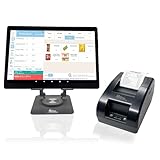
Mobile POS Cash Register 10.1” Tablet 2“ Receipt Printer Lifetime Software app for Small Business Restaurant Retail Grocery Convenience Mobile Food Dining car Bubble Tea Coffee Shop Beverage Bakery
- 10.1" 8-core tablet with Wi-Fi and Bluetooth support, equipped with a 2" Bluetooth receipt printer and a stable aluminum alloy tablet stand that rotates 360°. Compatible with optional label printers, receipt printers, kitchen ticket printers, order ticket printers, barcode scanners, and electronic scales. Runs on a reliable Android operating system with built-in POS software. Hardware comes with a 1-year limited warranty
- You can download our mobile app in iOS and Android for settings, charts, reports, and storage management. We provide a online food ordering system. You or your customers can simply scan a QR code to place food orders via phone for to go delivery dine in
- LIFETIME SOFTWARE - Fast checkout, easy ordering and setup. User-friendly interface. The POS APP comes pre-installed and configured. The software is available for life and includes 1 year of customer service, 3 months of remote support, and 3 months of iCloud. No contract required, no mandatory fees
- We support payment terminals and Visa, Mastercard, Google Pay, and Apple Pay. If you sign up for our merchant services and begin accepting credit card payments after three months, we will refund you $200 for your business. Once your application is approved, you will receive a free EMV & credit card terminal
- Multifunctional-POS system, inventory management, tip tracking, membership system, reporting app, multi-region tax rate calculation, and more
What affects how much a coffee shop makes a month
- Location, Location, Location: High-traffic areas, near offices, or busy retail spots mean more potential customers. A quiet side street? Tougher sledding.
- Menu Pricing: Are your prices competitive but profitable? Too low and you leave money on the table. Too high and customers might walk.
- Product Mix: Espresso-based drinks and specialty items often have higher profit margins than basic drip coffee. Pastries and grab-and-go food can also be big earners.
- Customer Volume: How many people walk through your door daily? This is directly tied to location and marketing.
- Average Transaction Value: What’s the average amount a customer spends? Encouraging add-ons like pastries or larger sizes can bump this.
- Operating Costs: Rent is a killer. So is labor. Keeping these in check is crucial for profit.
- Seasonality: Coffee shops can see spikes in summer (iced drinks) and dips in certain months. Planning for this is key.
- Competition: How many other coffee spots are nearby? What are they offering?
- Brand and Atmosphere: A welcoming vibe and good reputation draw people in and keep them coming back. It’s more than just coffee.
- Marketing and Promotions: Happy hour specials, loyalty programs, local partnerships – these can drive sales.
- Efficiency: Streamlined operations, good staff training, and smart inventory management reduce waste and speed up service.
- Quality of Product: Great coffee and food keep customers happy and loyal. Word-of-mouth is powerful.
Pros, cons, and when it matters
- Pro: High Potential Margins on Specialty Drinks: That fancy latte can have a great profit margin. Matters when you’re aiming for that higher net income.
- Con: High Overhead Costs: Rent in a prime spot? Payroll for a decent crew? These are big, constant drains. Matters if you underestimate your fixed costs.
- Pro: Repeat Business: Coffee is a habit. Loyal customers are the backbone of a stable shop. Matters for long-term revenue.
- Con: Intense Competition: You’re likely not the only game in town. Matters for customer acquisition and retention.
- Pro: Community Hub Potential: A coffee shop can become a local gathering place. Matters for building brand loyalty and positive buzz.
- Con: Dependence on Foot Traffic: If people aren’t walking by, they aren’t buying. Matters for location selection.
- Pro: Scalability: You can open more locations or expand your offerings. Matters if you have a winning formula.
- Con: Staffing Challenges: Finding and keeping good baristas can be tough. Matters for service quality and operational smoothness.
- Pro: Relatively Low Startup Costs (compared to some businesses): You don’t need massive machinery to start. Matters if you’re bootstrapping.
- Con: Thin Margins on Basic Drip Coffee: The profit on a simple cup of black coffee is often pretty slim. Matters for understanding your overall profit drivers.
- Pro: Flexibility in Menu: You can adapt to trends and customer demand. Matters for staying relevant.
- Con: Sensitivity to Economic Downturns: People might cut back on non-essentials like fancy coffees when money is tight. Matters for forecasting during tough times.
Common misconceptions
- Myth: All coffee shops are cash cows. Nope. Many operate on thin margins, especially in competitive areas.
- Myth: You can just open and people will come. Location, marketing, and a good product are essential. It takes effort.
- Myth: Drip coffee is where the real money is. While high volume, the profit per cup is usually lower than specialty drinks.
- Myth: Staffing costs are fixed. They fluctuate with hours, overtime, and benefits. It’s a dynamic expense.
- Myth: You can ignore your competitors. You need to know what they’re doing, pricing, and offering. Stay aware.
- Myth: Online reviews don’t matter that much. They absolutely do. Good reviews drive new customers. Bad ones can kill your reputation.
- Myth: You’ll be swimming in cash from day one. Most businesses take time to build momentum and reach profitability. Be patient.
- Myth: Coffee is just coffee. Quality of beans, roasting, and brewing technique make a huge difference. Customers notice.
- Myth: A great location is all you need. It helps, but you still need to execute well on product, service, and atmosphere.
- Myth: Marketing is a one-time thing. It’s an ongoing effort to attract and retain customers.
FAQ
- How much gross revenue can a small coffee shop expect monthly? A small shop in a decent location might see $10,000 to $25,000 in gross revenue per month. It really depends on how busy you are and what you’re selling.
- What’s a realistic profit margin for a coffee shop? Profit margins can vary widely, but many aim for 10-20% net profit. Some do better, some struggle to break even.
- Does a coffee shop’s location significantly impact monthly earnings? Absolutely. A shop on a busy street corner or near offices will likely earn far more than one in a less trafficked area.
- How important is the menu in determining monthly revenue? Very. Offering high-margin items like specialty espresso drinks, pastries, and merchandise can significantly boost your average ticket size and overall revenue.
- Can a coffee shop owner make a living wage from a single location? It’s possible, but it requires careful management of costs and consistent sales. Many owners reinvest profits back into the business initially.
- What are the biggest expenses that cut into a coffee shop’s monthly profits? Rent and labor are usually the top two. Utilities, COGS (beans, milk, cups), and marketing also add up quickly.
- How do loyalty programs affect monthly revenue? They encourage repeat business, which is crucial. Loyal customers spend more over time and can become brand advocates.
- Is it harder to make money in a city versus a suburban area? Both have pros and cons. Cities might have higher foot traffic but also higher rents and more competition. Suburbs might have lower costs but potentially less volume.
What this page does NOT cover (and where to go next)
- Detailed financial modeling for specific business plans.
- Specific marketing strategies or advertising tactics.
- The nuances of commercial real estate leases.
- Legal and regulatory requirements for opening a food service business.
- Advanced inventory management techniques.