
Brewing Masala Chai with a Coffee Twist
Quick answer
- Use your coffee maker’s hot water dispenser.
- Pre-mix your chai spices and tea.
- Steep the chai mixture in hot water, not brew it directly.
- Add milk and sweetener to taste after steeping.
- Consider a French press for a more controlled steep.
- Don’t run chai through your coffee filter unless you want a mess.
Who this is for
- Coffee lovers who enjoy a spiced tea break.
- Campers looking for versatile ways to use their coffee gear.
- Anyone curious about infusing familiar brewing tools with new flavors.
What to check first
Brewer type and filter type
Know your setup. Is it a drip machine, a pour-over, or something else? Most coffee makers are designed for coffee grounds and paper filters. Trying to brew loose chai leaves directly in a drip basket can clog things up fast. Paper filters might hold back some spice particles, but they aren’t ideal for tea leaves.
Water quality and temperature
Good water makes good drinks. If your tap water tastes funky, your chai will too. Filtered water is usually the way to go. For chai, you want it hot, but not necessarily boiling. Around 200°F (93°C) is a sweet spot, just like for coffee. Your coffee maker’s hot water function is often perfect for this.
Grind size and coffee freshness
This is a bit different for chai. You’re not grinding coffee beans. You’ll want your tea leaves and spices to be a medium to coarse size for steeping. If you buy pre-ground chai mix, that’s fine. If you’re grinding your own whole spices, aim for something that won’t pass through a fine mesh. Freshness matters for tea, too. Old tea can taste flat.
Coffee-to-water ratio
For chai, we’re talking about tea-to-water. A good starting point is about 1-2 teaspoons of chai mix per 8 oz of water. This is flexible. Some like it strong, some like it mild. Experiment to find your sweet spot. It’s not like coffee where a precise ratio is often key to balance.
Cleanliness/descale status
This is huge. If your coffee maker is gunked up with old coffee oils or mineral buildup, your chai will taste like a dirty coffee maker. Run a descaling cycle if it’s been a while. A clean machine means clean flavor for whatever you’re brewing.
Step-by-step (brew workflow)
1. Gather your ingredients.
- What to do: Get your favorite chai tea blend (loose leaf or tea bags), water, milk (dairy or non-dairy), and sweetener (sugar, honey, etc.).
- What “good” looks like: Everything is within reach and ready to go. No scrambling mid-brew.
- Common mistake: Forgetting the milk or sweetener. Avoid this by laying it all out first.
2. Heat the water.
- What to do: Use your coffee maker’s hot water dispenser. If it doesn’t have one, use a kettle. Aim for around 200°F (93°C).
- What “good” looks like: Hot water, but not violently boiling. It’s ready to extract flavor.
- Common mistake: Using boiling water. This can scorch delicate tea leaves and make the chai bitter. Let it cool for a minute if it’s too hot.
3. Prepare your steeping vessel.
- What to do: This could be a mug, a French press, or a small teapot. If using a French press, make sure it’s clean.
- What “good” looks like: A clean container ready to hold your chai and hot water.
- Common mistake: Using a vessel that still smells like coffee. Rinse it thoroughly.
4. Add chai to the vessel.
- What to do: If using loose leaf chai, add 1-2 teaspoons per 8 oz of water. If using tea bags, use one bag per serving.
- What “good” looks like: The right amount of chai is in the vessel. You can see the spices and tea.
- Common mistake: Overfilling the vessel. This can lead to a weak brew or a mess when you add water.
5. Pour hot water over the chai.
- What to do: Carefully pour the heated water into your steeping vessel, covering the chai leaves or bags.
- What “good” looks like: The chai is fully submerged and begins to release its aroma.
- Common mistake: Not using enough water. This results in a concentrated, often bitter, brew.
6. Steep the chai.
- What to do: Let it steep for 3-5 minutes. Adjust time based on how strong you like it.
- What “good” looks like: The water turns a rich amber color, and the aroma fills the air.
- Common mistake: Steeping too long. This extracts tannins, making the chai bitter and astringent.
7. Strain or remove tea bags.
- What to do: If using loose leaf chai in a mug, use a fine-mesh strainer to pour the chai into another mug. If using a French press, slowly press the plunger down. Remove tea bags.
- What “good” looks like: You have a clear, brewed chai liquid, free of leaves or bag fragments.
- Common mistake: Not straining well enough. Little bits of leaf can ruin the texture.
For loose leaf chai, a good tea infuser can make straining much easier. Consider a durable tea infuser to ensure a smooth, leaf-free brew.
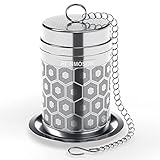
- Upgraded Micron Mesh: loose leaf tea steeper is Ideal to hold tea leaves, particles, or ground coffee. Compared to traditional tea strainer, our tea ball features 50% more ultra fine, half-sized holes for optimal tea flavor and minimal sediment leak. Ideal for rooibos, herbs, green tea, Chai, ground coffee, small tea leaves and etc.
- High-Quality Materials: Made of 304 food-grade stainless steel, tea ball infuser for loose tea is easier to be cleaned. Besides, loose tea steeper ensures no metallic taste on your tea or coffee and never rust for years of use. Money-saving and eco-friendly alternative to disposable tea bags and paper filters.
- Easy to Open and Close: With the design of thread top, the lids screw easily and are much more secure than the traditional twist lid, so the tea leaves will be held tightly and the lid never escapes during the process of brewing.
- Wide Application: tea steeper is not only for loose tea leaves but also a spice filter, infusing spices, herbs, and seasonings in soups, sauce, broths, and stews. Extended 4.3” chain with S-handle makes tea infusers can catch securely on any rim of mugs, cups, teapots, kettles, bottles, and pitchers.
- Package: Comes with 1.5” diameter and 2.2” high tea balls for loose tea and 1 saucer. The saucer is helpful for avoiding making a mess when you take out the loose leaf tea infusers after brewing.
8. Add milk.
- What to do: Warm your milk separately (microwave or stovetop) or add cold milk directly to the chai. The amount is up to you.
- What “good” looks like: The chai takes on a creamy, lighter color.
- Common mistake: Adding cold milk to super-hot chai in a delicate mug. It can sometimes crack ceramic. Warm the milk first.
9. Sweeten to taste.
- What to do: Stir in your preferred sweetener until it dissolves.
- What “good” looks like: The chai is perfectly balanced between spicy, creamy, and sweet.
- Common mistake: Adding too much sweetener. You can always add more, but you can’t take it out.
10. Serve and enjoy.
- What to do: Pour into your favorite mug and savor.
- What “good” looks like: A comforting, aromatic cup of spiced tea.
- Common mistake: Rushing the enjoyment. Take a moment to appreciate the aroma and flavor.
Common mistakes (and what happens if you ignore them)
| Mistake | What it causes | Fix |
|---|---|---|
| Brewing chai directly in drip basket | Clogged filter, weak brew, messy cleanup | Steep in a separate vessel, use hot water dispenser. |
| Using boiling water for steeping | Scorched tea, bitter flavor | Use water around 200°F (93°C), let boiling water cool briefly. |
| Over-steeping the chai | Bitter, astringent, unpleasant taste | Steep for 3-5 minutes, adjust to your preference. |
| Not straining loose leaves properly | Gritty texture, bits in your drink | Use a fine-mesh strainer, ensure the French press plunger is effective. |
| Using a dirty coffee maker/vessel | Off-flavors, stale taste | Clean and descale your brewer, rinse steeping vessels thoroughly. |
| Adding too much sweetener | Overly sweet, masks chai flavors | Start with a little, add more as needed. |
| Not pre-heating your mug (optional) | Drink cools too quickly | Warm your mug with hot water before adding the chai. |
| Using old, stale tea leaves/spices | Flat, uninspired flavor | Use fresh, good-quality chai ingredients. |
| Incorrect tea-to-water ratio (too much) | Overpowering, bitter taste | Start with 1-2 tsp per 8 oz, adjust to preference. |
| Incorrect tea-to-water ratio (too little) | Weak, watery, unsatisfying flavor | Start with 1-2 tsp per 8 oz, adjust to preference. |
Decision rules (simple if/then)
- If your coffee maker has a hot water dispenser, then use it for heating your chai water because it’s convenient and usually at the right temperature.
- If you have a French press, then consider using it for steeping chai because it offers good control and easy straining.
- If your chai has very fine particles, then use a tighter strainer or a French press to avoid sediment in your cup because fine particles can make the drink gritty.
- If your chai tastes bitter, then you likely over-steeped it or used water that was too hot, so try a shorter steep time or slightly cooler water next time.
- If your chai tastes weak, then you might need to use more chai leaves or steep for a bit longer because insufficient extraction leads to a watery flavor.
- If you want a traditional milky chai, then warm your milk separately before adding it because it integrates better and avoids cooling your chai too much.
- If you’re sensitive to caffeine, then opt for a decaffeinated chai blend or use fewer tea leaves because most chai blends contain black tea, which has caffeine.
- If you’re using a paper filter for some reason, then expect some flavor bleed-through and potential clogging, so it’s best to avoid it for chai.
- If you notice off-flavors, then clean your coffee maker thoroughly, including running a descaling cycle, because residual coffee oils or mineral buildup will ruin the chai taste.
- If you like a very strong, concentrated chai base, then steep it longer and stronger, then dilute it with hot water or milk to your liking because this gives you flexibility.
- If you’re experimenting with whole spices, then grinding them to a coarse consistency is usually best for steeping because fine grinds can become bitter and harder to strain.
FAQ
Can I really use my coffee maker to make chai?
Yes, but not in the way you brew coffee. Use its hot water dispenser to heat water for steeping, or use it as a general hot water source. Don’t put chai leaves in the coffee basket.
What’s the best way to steep chai leaves using coffee gear?
The easiest way is to heat water with your coffee maker’s hot water function, then pour it over chai leaves in a separate mug or French press to steep.
Why does my chai taste bitter when I use my coffee maker?
It’s probably not the coffee maker itself, but how you’re using it. Boiling water or over-steeping the chai leaves will cause bitterness, regardless of the heating method.
How much chai mix should I use?
A good starting point is 1 to 2 teaspoons of chai blend per 8 ounces of water. Adjust this based on your preference for strength.
What kind of milk is best for chai?
Any milk works! Dairy milk, oat milk, almond milk, or soy milk all create a creamy texture. Warm the milk before adding it for a smoother integration.
Can I use tea bags instead of loose leaf chai?
Absolutely. Tea bags are convenient and work just fine. Use one bag per 8 ounces of water and steep as directed.
How do I clean my coffee maker after making chai?
If you only used the hot water dispenser, a simple rinse of the reservoir is usually enough. If any chai accidentally got into the brewing mechanism, run a cleaning cycle with water.
Is there caffeine in chai?
Most traditional chai blends are made with black tea, which contains caffeine. If you’re sensitive, look for decaffeinated chai blends.
What this page does NOT cover (and where to go next)
- Specific chai spice blends and their health benefits. (Explore spice guides.)
- Advanced latte art techniques for chai lattes. (Look into barista guides.)
- The history of chai and its cultural significance. (Research beverage histories.)
- Detailed comparisons of different types of tea leaves used in chai. (Dive into tea connoisseur resources.)