
Coffee-to-Water Ratio Guide: The Complete Reference for Perfect Brew Strength
# Coffee-to-Water Ratio Guide: The Complete Reference for Perfect Brew Strength
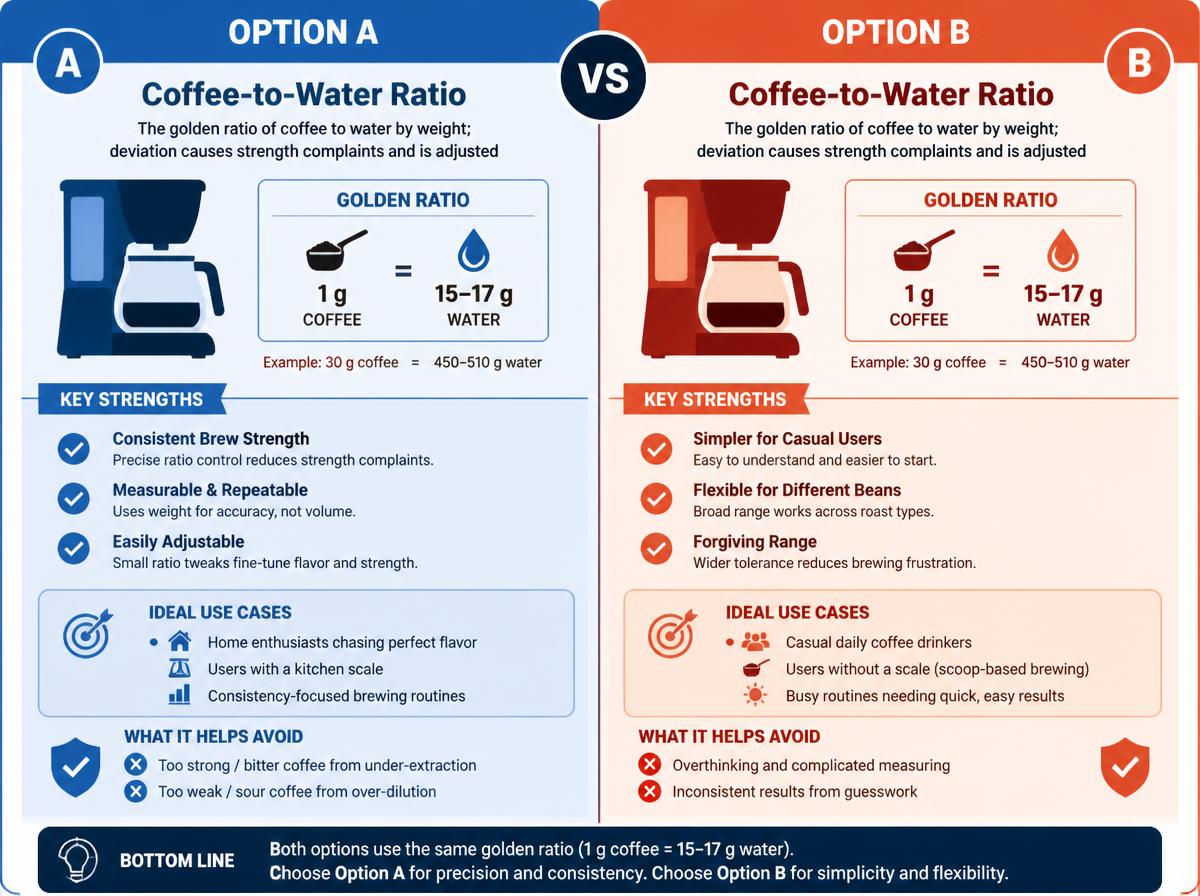
## The Golden Ratio — Why 1:16 to 1:18 Matters
Related: our guide: Espresso Beans vs Coffee Beans.
Related: our brew method comparison guide.
The Specialty Coffee Association (SCA) has spent decades perfecting a single, repeatable standard for coffee brewing: the Golden Ratio of **1:16 to 1:18**. This means for every **1 gram of coffee**, you use **16 to 18 grams (or milliliters) of water**. At room temperature, 1 ml of water weighs 1 gram, making this ratio easy to measure by weight.
Why does this range matter so much? Because it unlocks the sweet spot of extraction. Coffee is roughly 30% soluble material, but we only want to dissolve about 18–22% of those solids into your cup. Below 1:16, the brew becomes over‑extracted, bitter, and harsh. Above 1:18, it turns under‑extracted, sour, and weak. The Golden Ratio delivers balanced flavor, pleasant acidity, and the full aromatic profile of your beans.
A 1:17 ratio (mid‑range) is the most versatile starting point for any brew method. From there, you can adjust by 0.5 increments to suit your taste. If you’re using a scale for the first time, set it to grams, zero out your vessel, and add coffee until you hit the ratio. Most coffee lovers find that 1:16 is punchy and bold, while 1:18 is clean and tea‑like.
## Ratio by Brew Method
Every brewing method extracts coffee differently based on contact time, pressure, and water temperature. The ideal ratio shifts accordingly. Here is your complete reference table:
| Method | Ratio (Coffee:Water) | Coffee (g) per cup | Water (ml) per cup | Brew Time | Grind Size |
|—|—|—|—|—|—|
| **Drip** (auto) | 1:16 – 1:18 | 10 – 12 g | 180 – 200 ml | 4 – 6 min | Medium |
| **French Press** | 1:15 – 1:17 | 12 – 15 g | 200 – 220 ml | 4 min | Coarse |
| **Pour Over** | 1:16 – 1:17 | 12 – 15 g | 200 – 220 ml | 2.5 – 4 min | Medium‑Fine |
| **Cold Brew** | 1:8 – 1:10 | 25 – 30 g | 200 ml | 12 – 24 hr | Coarse |
| **Espresso** | 1:2 – 1:3 | 18 – 20 g | 36 – 60 ml | 25 – 30 sec | Fine |
| **AeroPress** | 1:15 – 1:17 | 12 – 15 g | 200 ml | 1 – 2 min | Medium‑Fine |
| **Percolator** | 1:15 – 1:18 | 10 – 12 g | 150 – 180 ml | 5 – 10 min | Medium‑Coarse |
| **Moka Pot** | 1:10 – 1:12 | 15 – 18 g | 150 – 180 ml | 3 – 5 min | Medium‑Fine |
**Key takeaways from the table:**
– **Drip brewers** like the [OVENTE 12-Cup Drip Coffee Maker](https://www.amazon.com/dp/B0CDFFF1P5?tag=coffeemachinede-20&linkCode=ogi&th=1&psc=1) or the [Horavie 10 Cup Programmable Drip Coffee Maker](https://www.amazon.com/dp/B0GQDZD7Y7?tag=coffeemachinede-20&linkCode=ogi&th=1&psc=1) naturally match the 1:16–1:18 range. Use a medium grind and a brew time of 4–6 minutes for a clean, bright cup.
– **French Press** requires a coarser grind and a slightly stronger ratio (1:15–1:17) because the metal mesh lets more fines through. Try the [Utopia Kitchen 304 Grade Stainless Steel French Press](https://www.amazon.com/dp/B01G2CCWGY?tag=coffeemachinede-20&linkCode=ogi&th=1&psc=1) or the larger [Belwares 50oz French Press](https://www.amazon.com/dp/B08NTWQLB6?tag=coffeemachinede-20&linkCode=ogi&th=1&psc=1) for full‑bodied immersion brewing.
– **Pour Over** benefits from a medium‑fine grind and a steady pour. The [APOXCON Automatic Drip Coffee Maker](https://www.amazon.com/dp/B0GKNN4QRN?tag=coffeemachinede-20&linkCode=ogi&th=1&psc=1) simulates hand‑pour patterns with programmable precision.
– **Cold Brew** concentrates at 1:8–1:10. Dilute the concentrate 1:1 with water or milk before drinking.
– **Espresso** is extremely concentrated at 1:2–1:3. A typical double shot uses 18–20 g of fine grounds for 36–60 ml of liquid.
– **AeroPress** is forgiving: 1:15–1:17 works well for a clean cup in under 2 minutes.
– **Percolator** and **Moka Pot** produce strong, bold coffee. Use medium‑fine to medium‑coarse grind and adjust ratio toward the stronger end for more body.
We recommend starting every new method at **1:17** and adjusting based on taste. If the coffee tastes hollow or sour, use less water (move toward 1:15). If it tastes bitter or astringent, use more water (move toward 1:18).
## Coffee Calculator — Convert Beans to Cups Like a Pro
Understanding ratios is one thing; applying them to real‑world scenarios is another. Use these formulas to calculate exactly how much coffee you need.
### How Many Cups From 1 kg of Beans?
Using the Golden Ratio (1:17) and a standard 200 ml cup:
– **1 kg = 1000 grams of coffee**
– **Water per cup** = 200 ml (200 g)
– **Coffee per cup** = 200 g ÷ 17 = **11.8 g** (round to 12 g)
**1000 g ÷ 12 g per cup ≈ 83 cups**
So one kilogram of whole beans yields roughly **80–85 cups** of brewed coffee at the Golden Ratio. For stronger methods like French Press (1:15, ~13 g per cup), you get about **77 cups**. For espresso (1:2.5, ~18 g per double shot), you get about **55 double shots**.
### How Much Coffee for 12 Cups?
A 12‑cup batch is the standard for most drip machines. Here is the math:
– **Desired water** = 12 cups × 200 ml = 2400 ml (2400 g)
– **Coffee needed (1:17)** = 2400 ÷ 17 = **141 g**
– **Coffee needed (1:16)** = 2400 ÷ 16 = **150 g**
– **Coffee needed (1:18)** = 2400 ÷ 18 = **133 g**
So for a 12‑cup pot, use **133–150 grams** of medium‑ground coffee. Machines like the [BLACK+DECKER 12-Cup Digital Coffee Maker](https://www.amazon.com/dp/B01GJOMWVA?tag=coffeemachinede-20&linkCode=ogi&th=1&psc=1) or the [BLACK+DECKER 12-Cup with Vortex Technology](https://www.amazon.com/dp/B0C8B9V7HR?tag=coffeemachinede-20&linkCode=ogi&th=1&psc=1) can handle this easily. The [Horavie 10 Cup Programmable Drip Coffee Maker](https://www.amazon.com/dp/B0GQDZD7Y7?tag=coffeemachinede-20&linkCode=ogi&th=1&psc=1) is perfect for smaller households.
### Tablespoons Per Cup With Grams Conversion
A level tablespoon of ground coffee weighs approximately **5 grams**. This varies slightly by roast level (darker roasts are lighter per volume) and grind size, but 5 g is a reliable average.
**Conversion:**
– **1 cup (200 ml)** at 1:17 → 12 g coffee → **2.4 tablespoons**
– **1 cup** at 1:16 → 12.5 g → **2.5 tablespoons**
– **1 cup** at 1:18 → 11 g → **2.2 tablespoons**
For simplicity, **2 heaping tablespoons per cup** is a good rule of thumb for the Golden Ratio. If you’re using a scoop, look for one that holds 10–12 g (about 2 level tablespoons). The [Mr. Coffee 3-in-1 Single-Serve Iced and Hot Coffee/Tea Maker](https://www.amazon.com/dp/B09JZR6XWC?tag=coffeemachinede-20&linkCode=ogi&th=1&psc=1) includes a reusable filter and scoop right out of the box.
### Caffeine Per Cup by Method
Caffeine content varies with ratio, brew time, and bean origin. The following are approximate values for a single serving:
| Method | Serving size | Caffeine (mg) |
|—|—|—|
| Drip coffee | 200 ml | 80 – 120 mg |
| French Press | 200 ml | 80 – 120 mg |
| Pour Over | 200 ml | 80 – 120 mg |
| Cold Brew (concentrate) | 200 ml (undiluted) | 150 – 200 mg |
| Espresso (single) | 30 ml | 60 – 80 mg |
| AeroPress | 200 ml | 80 – 120 mg |
| Moka Pot | 150 ml | 100 – 150 mg |
Cold brew concentrate can pack nearly twice the caffeine of drip coffee because of the high coffee‑to‑water ratio. Espresso is more concentrated per volume, but a standard serving is much smaller.
## Quick Reference Table — Cups to Coffee Grounds
Use this table when you don’t have a scale handy. One “cup” equals **200 ml (6.8 oz)** of brewed coffee. Tablespoons are level.
| Cups | Coffee (Tbsp) | Coffee (grams) | Coffee (oz) |
|—|—|—|—|
| 1 | 2 Tbsp | 10 g | 0.35 oz |
| 2 | 4 Tbsp | 20 g | 0.70 oz |
| 3 | 6 Tbsp | 30 g | 1.05 oz |
| 4 | 8 Tbsp | 40 g | 1.40 oz |
| 5 | 10 Tbsp | 50 g | 1.75 oz |
| 6 | 12 Tbsp | 60 g | 2.10 oz |
| 7 | 14 Tbsp | 70 g | 2.45 oz |
| 8 | 16 Tbsp | 80 g | 2.80 oz |
| 9 | 18 Tbsp | 90 g | 3.15 oz |
| 10 | 20 Tbsp | 100 g | 3.50 oz |
| 11 | 22 Tbsp | 110 g | 3.85 oz |
| 12 | 24 Tbsp | 120 g | 4.20 oz |
**Pro tip:** For a 12‑cup pot using the table above, you’d use **24 tablespoons (120 g)** of coffee. But remember the Golden Ratio calculator said 133–150 g for 12 cups — the table uses a slightly weaker ratio (about 1:20) because volume measures are less precise. For accurate results, always weigh your coffee. A digital scale is the single best investment you can make for consistent brewing.
## Common Mistakes — And How to Fix Them
Even with the perfect ratio, several pitfalls can ruin your cup. Here are the most common ones and how to avoid them.
### 1. Coffee Too Weak or Too Strong
If your coffee tastes watery or thin, you’re likely using too little coffee. Increase the dose by 1–2 g per cup. If it’s bitter, harsh, or overpowering, you’re using too much coffee — reduce the dose slightly. The Golden Ratio (1:16–1:18) is your anchor. Small adjustments of 0.5 g per cup make a noticeable difference.
### 2. Wrong Grind Size
Grind size controls extraction speed. If your coffee tastes sour (under‑extracted), your grind is too coarse — make it finer so water spends more time extracting. If it tastes bitter (over‑extracted), your grind is too fine — make it coarser to reduce extraction. A medium grind works for most drip machines. French Press needs coarse. Pour Over needs medium‑fine. Espresso needs fine. Always match grind size to your brew method.
### 3. Wrong Water Temperature
The ideal water temperature for brewing is **90–96°C (195–205°F)**. Water that is too hot (boiling at 100°C) over‑extracts and burns delicate flavors. Water that is too cold (below 88°C) under‑extracts and leaves the coffee flat. If you don’t have a temperature‑controlled kettle, bring water to a boil and let it rest for 30–45 seconds before pouring. Many modern drip machines, like the [OVENTE 12-Cup Drip Coffee Maker](https://www.amazon.com/dp/B0CDFFF1P5?tag=coffeemachinede-20&linkCode=ogi&th=1&psc=1) and the [APOXCON Automatic Pour Over](https://www.amazon.com/dp/B0GKNN4QRN?tag=coffeemachinede-20&linkCode=ogi&th=1&psc=1), regulate temperature automatically for consistent results.
### 4. Stale Coffee
Coffee reaches peak flavor within 2–4 weeks of roasting. After that, it loses aroma and tastes flat or papery. Buy whole beans in small batches (enough for 1–2 weeks) and grind just before brewing. Store beans in an airtight container away from light, heat, and moisture. Never refrigerate or freeze your daily coffee — condensation introduces moisture that accelerates staling.
### 5. Inconsistent Measurements
Using a scoop or tablespoon instead of a scale introduces huge variability. A “tableSpoon” can vary by 2–3 grams depending on how you fill it (level vs. heaping, dark vs. light roast). Invest in a kitchen scale that reads to 0.1 g. It is the single most important tool for repeatable, excellent coffee.
### 6. Not Pre‑wetting the Filter
Paper filters absorb some of the coffee oils and can impart a paper taste if not rinsed. Always rinse your paper filter with hot water before adding grounds. This warms the brewer and eliminates any off‑flavors. A reusable filter (like the one included with the [Horavie 10 Cup Programmable Drip Coffee Maker](https://www.amazon.com/dp/B0GQDZD7Y7?tag=coffeemachinede-20&linkCode=ogi&th=1&psc=1)) avoids this issue entirely.
### 7. Letting Coffee Sit on the Hot Plate
Leaving brewed coffee on a hot plate for more than 20 minutes degrades the flavor, turning it bitter and cooked. Brew only what you’ll drink within 20–30 minutes, or transfer the coffee to a thermal carafe. If you need to keep coffee hot for longer, consider a brewer with a thermal carafe instead of a glass one.
## Recommended Scales & Scoops
Precision is the secret to great coffee. Here are our top picks for tools that will help you dial in the perfect brew every time.
### Best Drip Coffee Makers
For a reliable, programmable experience, the **OVENTE 12-Cup Drip Coffee Maker** ([check on Amazon](https://www.amazon.com/dp/B0CDFFF1P5?tag=coffeemachinede-20&linkCode=ogi&th=1&psc=1)) features a borosilicate glass carafe, one‑touch operation, anti‑drip system, and a reusable filter — perfect for households that want consistent 1:16–1:18 brewing.
The **Horavie 10 Cup Programmable Drip Coffee Maker** ([check on Amazon](https://www.amazon.com/dp/B0GQDZD7Y7?tag=coffeemachinede-20&linkCode=ogi&th=1&psc=1)) offers adjustable brew strength, pause & serve, auto shut‑off, and a permanent filter in a compact stainless steel body — great for home or office.
If you love the precision of pour‑over but want automation, the **APOXCON Automatic Drip Coffee Maker** ([check on Amazon](https://www.amazon.com/dp/B0GKNN4QRN?tag=coffeemachinede-20&linkCode=ogi&th=1&psc=1)) simulates hand‑pouring with a programmable timer, built‑in scale, and adjustable strength. It’s a game‑changer for ratio‑conscious brewers.
For versatility, the **Mr. Coffee 3-in-1 Single-Serve Iced and Hot Coffee/Tea Maker** ([check on Amazon](https://www.amazon.com/dp/B09JZR6XWC?tag=coffeemachinede-20&linkCode=ogi&th=1&psc=1)) makes both iced and hot beverages, comes with a blender, reusable filter, scoop, recipe book, and two tumblers with lids and straws. Ideal for single‑serve flexibility.
The **BLACK+DECKER 12-Cup Digital Coffee Maker** ([check on Amazon](https://www.amazon.com/dp/B01GJOMWVA?tag=coffeemachinede-20&linkCode=ogi&th=1&psc=1)) is a workhorse: programmable, washable basket filter, Sneak‑A‑Cup™ feature, auto brew, water window, and keep‑hot plate. For a simpler, affordable option, the **BLACK+DECKER 12-Cup with Vortex Technology** ([check on Amazon](https://www.amazon.com/dp/B0C8B9V7HR?tag=coffeemachinede-20&linkCode=ogi&th=1&psc=1)) features an easy on/off switch, non‑drip carafe, and removable filter basket.
### Best French Press Coffee Makers
For full‑immersion brewing, the **Utopia Kitchen 304 Grade Stainless Steel French Press** ([check on Amazon](https://www.amazon.com/dp/B01G2CCWGY?tag=coffeemachinede-20&linkCode=ogi&th=1&psc=1)) offers a 34 oz capacity, double‑wall insulation, 4‑level filtration, and two extra filters — all rust‑free and dishwasher safe.
If you need a larger batch, the **Belwares French Press** ([check on Amazon](https://www.amazon.com/dp/B08NTWQLB6?tag=coffeemachinede-20&linkCode=ogi&th=1&psc=1)) holds 50 oz (6 cups), with 304 stainless steel, double‑wall insulation, 4‑level filtration, and two extra filters. It’s perfect for serving guests or meal‑prepping cold brew.
### Final Word on Scale & Scoop
We recommend picking up a **0.1 g precision digital scale** (many options available on Amazon for under $20) and a **stainless steel coffee scoop** that holds exactly 10–12 g. The scoop included with the Mr. Coffee 3‑in‑1 is a good start, but a dedicated scale will give you the consistency